
How to Improve Writing Skills for Creative and Professional Writers
Sean Glatch | September 1, 2026 |
Like anything else, writing is a skill that improves with practice. The more you do it, the better you get at it. This goes for writing literature, yes, but also writing emails, text messages, notes-to-self, and anything else we use language for. Whatever you need to write, this article covers how to improve writing skills for writers of all texts.
How to Improve Writing Skills: Contents
How to Improve Writing Skills: 6 Tips for Writing Success
Follow these tips to write better and improve your writing skills.
1. How to Improve Writing Skills: Know the Rules (Before You Break Them)
Writing is an art that has been perfected and sculpted over time. Because the written word is thousands of years old, writers have figured out what works well, what doesn’t, and how to make language actually do what we need it to.
The following list is not comprehensive, but it covers the basics of what good writing craft typically entails. Feel free to skip through these writing skills in the following menu.
Writing skills list:
- Grammar and Mechanics
- Show, Don’t Tell
- Writing Concisely
- Word Choice
- Sound and Prosody
- Literary Devices
- Know Your Audience
- Avoid Common Writing Mistakes
Article continues below…
Writing Skills Courses We Think You'll Love
We've hand-picked these courses to help you flourish as a writer.
Crafting a Story or Novel Chapter Using Forward-Moving Tension
How do writers tell stories with tension, action, and emotion? Learn how to write forward-moving tension in this 5 week...
Find Out More
Scene Study: Strengthen Your Writing with Compelling Scenes
Great stories are constructed with great scenes. Immerse your reader in your stories by learning the ropes of scene development.
Find Out More
Show and Tell: How to Write Captivating Memoir and Nonfiction
Your true story of healing or transformation can captivate and empower your readers. Learn how to balance showing the vivid...
Find Out MoreOr click below to view all courses.
See CoursesArticle continues…
Grammar and Mechanics
This is, without a doubt, the least sexy aspect of writing. Unless you’re like me, in which case you’re thrilled by discourse about the oxford comma.
In all seriousness, a solid grounding in writing includes a grounding in grammar and mechanics. These rules might feel tedious, but they’re necessary to good writing, as they exist to mediate the infinite possibilities language offers. We need grammar to understand one another.
A solid grounding in writing includes a grounding in grammar and mechanics. We need grammar to understand one another.
For a thorough—and not boring or tedious—grounding in English-language grammar and mechanics, I recommend Grammar Girl, a podcast on the mechanics of successful writing. You’ll find that language is a lot more fun to think about, and you won’t have to do any drills with verb tenses or semicolons.
At the same time, know that there’s a difference between polished writing and successful writing. Advice elsewhere in this article will help guide you through the importance of breaking rules and violating expectations to achieve something greater in your work.
Show, Don’t Tell
Your writing skills will be sharpened simply by honoring the “show, don’t tell” rule.
The rule is simple: giving your readers tangible experiences will impact them more than simply telling them what or how to feel.
Giving your readers tangible experiences will impact them more than simply telling them what or how to feel.
Here’s an example:
- Telling: The storm was terrifying.
- Showing: Whole trees split in the wind and lightning as sheets of rain whitened the world to a pitch bright nothing.
The rule is a cornerstone of contemporary writing craft. You don’t need to use it all the time, of course—typically, less important information can be summarized and told, rather than shown. But learning how to weave imagery into an experience for the reader will help make your writing more memorable.
For a class on this writing skill, check out Showing vs. Telling: Writing Vivid Descriptions.
To learn more about “show, don’t tell,” read our article here:
https://writers.com/show-dont-tell-writing
Writing Concisely
Knowing how to write using the fewest necessary words is one of the most important writing skills.
But know that concision is not the same as brevity. If brevity is briefness, concision simply means that every word in your writing is necessary—that you cannot reduce the word count, even if your sentences themselves are long.
Concision simply means that every word in your writing is necessary—that you cannot reduce the word count, even if your sentences themselves are long.
Concise writing means getting rid of redundancies, circuitous descriptions, and unnecessary words. But “unnecessary” is a rather difficult word to pin down, because necessary writing can reveal something about the author’s voice, perspective, or feeling that overly-brief language fails to capture.
I think Toni Morrison is a great example of this. Her writing is voice-driven and can sometimes feel prosaic, but when you interrogate her prose, you’ll find that every word is absolutely essential, that her words are dense with meaning. Here’s the opening of her novel Beloved:
124 was spiteful.
Full of a baby’s venom. The women in the house knew it and so did the children. For years each put up with the spite in his own way, but by 1873 Sethe and her daughter Denver were its only victims. The grandmother, Baby Suggs, was dead, and the sons, Howard and Buglar, had run away by the time they were thirteen years old—as soon as merely looking in a mirror shattered it (that was the signal for Buglar); as soon as two tiny hand prints appeared in the cake (that was it for Howard). Neither boy waited to see more; another kettleful of chickpeas smoking in a heap on the floor; soda crackers crumbled and strewn in a line next to the door sill. Nor did they wait for one of the relief periods: the weeks, months even, when nothing was disturbed. No. Each one fled at once—the moment the house committed what was for him the one insult not to be borne or witnessed a second time. Within two months, in the dead of winter, leaving their grandmother, Baby Suggs; Sethe, their mother; and their little sister, Denver, all by themselves in the gray and white house on Bluestone Road. It didn’t have a number then, because Cincinnati didn’t stretch that far. In fact, Ohio had been calling itself a state only seventy years when first one brother and then the next stuffed quilt packing into his hat, snatched up his shoes, and crept away from the lively spite the house felt for them.
A mean editor might try to cut out words that don’t contribute to strictly denotative meaning. For example, “The women in the house knew it and so did the children” could be rewritten as “the women and children knew it.”
But you lose two things in a rewrite like that: emphasis and voice. Emphasis, because placing the children at the end of the sentence underscores the unusual nature of the children’s knowledge; voice, because you can hear the person speaking to us as unique, intelligent, sharp, moved.
The extreme opposite of concise writing is purple prose, which is overly ornate language with little meaning.
Learn more about concision at our article here:
https://writers.com/concise-writing
Word Choice
The difference between the almost right word and the right word is really a large matter—’tis the difference between the lightning-bug and the lightning.
—Mark Twain (paraphrasing Josh Billings)
Twain puts it best. Having the right words for things is essential for any piece of successful writing. It is one of the writing skills honed throughout your lifetime of language.
Learning the ropes of concision is one way of choosing the right words, because concision is a process of eliminating the wrong ones. But successful word choice also occurs when you use the word that is unexpected, that is closest to the full truth of things, or that best represents your own voice and vision.
Successful word choice also occurs when you use the word that is unexpected, that is closest to the full truth of things, or that best represents your own voice and vision.
The writing skills described in this article are also oriented towards effective word choice. But word choice deserves special mention as it is the basis for all successful writing. Learn more about word choice at our article here:
https://writers.com/word-choice-in-writing
Sound and Prosody
Successful writing doesn’t just transmit meaning. It can sway the reader through musicality.
Language is sonic before it is written. These words on the page evoke sounds in your head. A good writer knows how to make language lyrical, attending to the sonic possibilities of words and their arrangements.
Writing that sounds good to the ear is called euphony. Writers might achieve euphony through devices like assonance, consonance, alliteration, or (especially for poets) meter and rhyme.
Good writers also know to variegate their sentence structures. A series of same-length sentences sucks to read. Short sentences are to-the-point. Long sentences can explore the full beauty or complexity of something; really, you want to keep the motion of your writing fluid and engaging so that your reader wants to keep reading.
A good writer knows how to make language lyrical, attending to the sonic possibilities of words and their arrangements.
You might, as you learn more about writing, also care about word etymologies. The English language borrows words from around the world, giving us a great pool of vocabularies to draw from. Words of Latin or Greek origin tend to be more abstract: obfuscate, interrogate, democracy, homogeny, etc. Words from Anglo-Saxon, Scandinavian, or Germanic origin are often more concrete or visual: sludge, nudge, spoke, bright, moon. Writers might stick to one set of etymologies for euphony, or know how to combine them for the sake of emphasis.
A similar device is cacophony, in which a piece of writing sounds harsh or dissonant. Cacophony is useful, too: a writer that wants to emphasize or evoke discordance can do so through writing that mismatches vowels and consonants or else overwhelms the ear.
Other devices, like parallelism or analogy, can further rely on musicality and sentence structure to advance or imply arguments and ideas.
For more on sound device, check out this article:
https://writers.com/sound-devices
Literary Devices
Literary devices are any strategy a writer uses to enhance meaning or create connections in their writing. The most common ones you’ve probably heard of, like metaphor, simile, or symbolism.
The use of literary devices is one of the most powerful writing skills you can hone, but also one of the trickiest. My advice: use literary devices when plain language fails.
Use literary devices when plain language fails.
Many early-stage writers try to pack their writing with metaphor and symbolism to make their work more literary. But “literariness” happens regardless of metaphor. The result of overused devices is that a piece of writing can be overly ornate or difficult to follow, sounding pretty but communicating nothing.
These devices are better used either organically or when plain language doesn’t say what you need it to. That way, the brilliance of your literary device is much more apparent, improving the rest of the work as a result.
To acquaint yourself with the many devices at a writer’s disposal, check out our article here:
https://writers.com/common-literary-devices
Know Your Audience
Who are you writing for? What are you writing towards?
As you move from writing to revision, it’s helpful to start thinking about your audience. The way you write for children, for example, will be different from how you write for scientists. The way you write a novel is different from how you might write a memoir, not just in terms of craft skills but also down to your word choice.
Learning how to improve writing skills means knowing how to write for your audience.
Learning how to improve writing skills means knowing how to write for your audience. A great piece of writing might fall flat if it’s written with the wrong audience in mind. These considerations matter as you start thinking about where and how you’ll publish your work, but make sure you ask yourself in revision who you expect to read your writing.
Avoid Common Writing Mistakes
New writers often make similar mistakes as they start their writing journeys. Yes, this includes poor grammar or word choice—but more often it’s things like refusing to read, refusing to write, and generally trying to come off as smart and literary.
Check out our article on common writing mistakes (and how to avoid them!) here:
https://writers.com/common-writing-mistakes
2. How to Improve Writing Skills: Know When and How to Break the Rules
At the risk of being tautological, creative writing is creative. Which means that writers are aided by knowing the rules, yes, but also knowing when to break them.
Above, I mentioned some useful writing skills for writers to know, including:
- Using conventional grammar, spelling, syntax, and punctuation.
- Showing instead of telling, emphasizing concrete and visual diction over abstract or inaccessible word choice.
- Writing concisely, which includes avoiding redundancies and unnecessary repetitions.
Now, here’s a piece of writing that breaks those rules.
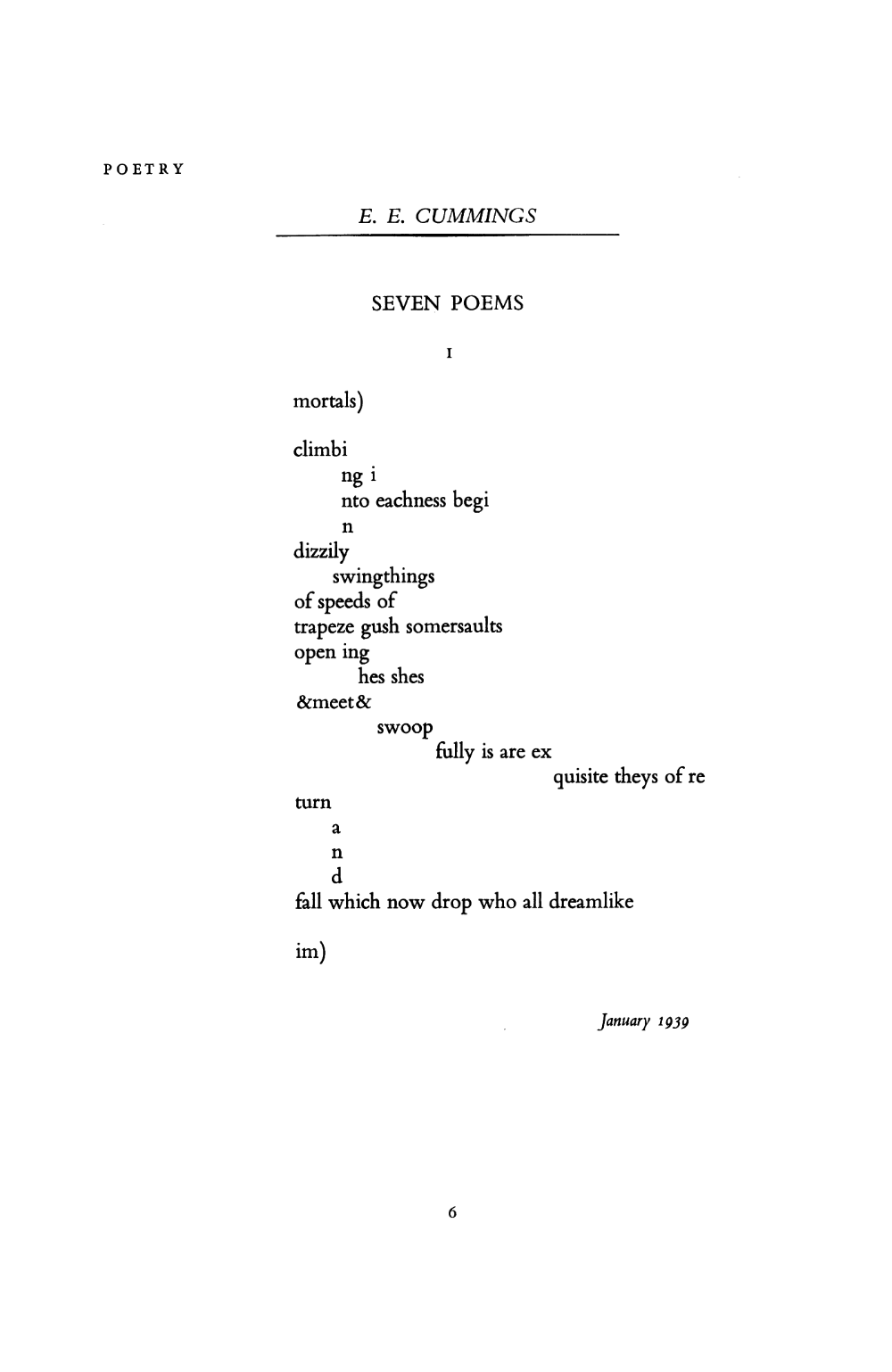
Despite its seeming incomprehensibility, this poem is successful precisely because it does break the rules. Cummings is a Modernist whose work (alongside the rise in typewriter usage) played with pagespace, syntax, and punctuation, evoking feelings through not just language but its physical arrangements.
That includes things like closed parentheses without open ones, line breaks in the middle of words themselves, indentations, the descending word “a n d” (preceded by ampersands), and the cacophony of phrases like “is are” or “climbing into eachness.”
In some cases, breaking the rules will be far more demonstrative than any attempt to follow the preordained pathways towards tangible meaning.
What does the poem evoke for you? For me, it’s the precarity and speed of life itself, whose random intensities interrupt time and linearity.
Cummings was the child of a Harvard professor and went to Harvard himself, studying both classical and contemporary literature. He knows the rules. And he knows that breaking them will be far more demonstrative than any attempt to follow the preordained pathways towards tangible meaning.
As you master the rules of writing craft, I encourage you to begin breaking them. Eventually, your writing skills will transcend the need for writing conventions, as you’ll find that there are different and better ways to say what you need to.
3. How to Improve Writing Skills: Read Regularly (and Like a Writer)
You will hear this advice throughout your writing career. Read. Read! Read all the time. Read daily, even if it’s only a page, only a paragraph, only a line a day. Read high art and bad art, read the terms and conditions, read what you want to write and read what you’ll never. And hey, while you’re at it, read our archive of craft articles.
What the advice doesn’t tell you is what to do with that reading. And what does this have to do with writing skills?
First, I encourage you to read like a writer. This phrase is a cornerstone of creative writing programs. What it means is to read a piece of writing and ask yourself why it is or isn’t successful.
Reading expands your world, helps you find your voice, and tells you what people are writing and publishing.
How did this piece of writing move you? Make its argument? Create a visual in your head? Can you do it in your own work? What would that look like?
Or, if the writing doesn’t land for you: What isn’t landing? What would you change to improve it? How do the elements that don’t work affect the rest of the piece?
Here are some other reasons that reading improves your writing skills:
- Reading expands your world. You discover more possibilities in language, draw upon greater vocabularies, find new works to reference, and stumble into more inspiration.
- Reading helps you find your voice. Every writer is composed of the voices that inform and undergird theirs. The more you read, the more you find approaches to language you like, don’t like, and incorporate into your own work.
- Reading tells you what people are writing. This sounds obvious, but if you’re a writer looking to publish in the contemporary marketplace, you want to know what other living writers are publishing. This gives you a clue into what people are reading; for better or worse, writers who want to make a career out of writing must think about how their writing fits into the literary marketplace.
- Reading, like writing, is an engagement with language. All engagements with language inform your work, whether consciously or unconsciously.
- You don’t know what you don’t know. Reading fixes that. The more you know about language and literature, the more you learn, on your own, how to write well and what hasn’t already been said and done by somebody else.
4. How to Improve Writing Skills: Take Risks and Challenge Yourself
Working out kind of sucks, right?
You have to pick weights that are a little too heavy for you to lift, push yourself to lift them until your body hurts, move around in the world kind of sore and kind of tired, and then repeat the process once you are no longer sore and tired.
But somehow, despite the pain and fatigue, it feels really good to be physically fit. You (ironically) have more energy for the day, your body is more resilient and adaptable, and eventually you move on to heavier weights and more complicated exercises.
Unfortunately, improving your writing skills is the exact same process.
The more you stumble into ideas and language you didn’t know you had inside of you, and the more you develop your craft.
You need to try new things, pursue ideas you don’t know how to pursue, write outside of your comfort zone, swing big, miss, swing again. The more you do this, the more you stumble into ideas and language you didn’t know you had inside of you, and the more you develop your craft.
I am primarily a poet. But I’ve found that the more I write into genres I’m not comfortable in—primarily fiction, though I’ll include experimental forms of poetry as well—the more I come back to my poetry with fresh ideas and insights. And the more I write poetry, the more I come to fiction with new approaches.
You might hear writers tell you that you need to write every day. I disagree. In the same way that working out requires rest, writing, too, has its fallow periods. Writers also grow through contemplation and silence. (You should still, of course, read when you’re not writing.) We are not machines, and I think the impetus to always produce writing results in some really pointless work.
But take risks, do something unusual, explore strange ideas, use writing or poetry prompts you dislike, try forms you’ve never tried, write like a writer who challenges you, write like a writer you hate—keep yourself at the borders of the unfamiliar, or throw yourself headfirst into strangeness. A lot of writing skills are discovered in the dark.
5. How to Improve Writing Skills: Develop Your Specificity and Voice
This is, I think, the most important thing any writer can do. Lean into your specificity.
Writers often think of writing as being in service of their message. They have something to say, and words allow them to say it. Which is true at the level of denotative meaning.
But actually, writing is in service of your unique and essential specificity.
Think of some writers you love the most. How, if you picked up a book without a title or author on the cover, you could still recognize their voice. How their approach to writing or their outlook on life has inspired your own life and writing.
Those writers do this precisely by not writing like anybody else. They read a lot, they wrote a lot, they broke the rules, they took risks—and as a result they have honed their specificity, writing with a voice that is once-in-history, never to be wielded by another writer again.
I see a lot of writers today trying to sound publishable, which is a different goal than trying to sound like themselves.
I see a lot of writers today trying to sound publishable, which is a different goal than trying to sound like themselves. Publishable writers are polished, immaculate; they follow the rules, they get the book deals. But they don’t have any real impact on the world. Their writing is entertaining but not noteworthy. Their readers pass the time politely engaged, but never richly inspired.
“Publishable” is a goal that appeals to the 50th percentile. It is writing for a Goodreads rating, not writing for the world. And it is not, for the record, writing that requires any great mastery of writing skills.
It is a brave and even dangerous thing to have a voice and write with it. Write in a way that no one else has. Read a lot, pick and choose what you like from that writing and disregard the rest. Avoid cliches, or, if you must use them, repurpose them to say something completely new.
It may be the case that everything has already been said. But it hasn’t been said in your voice, with your language, your specificity. Get weird and unadulterated and entirely yourself. There’s no real guide to doing it, but it is the most important thing you can do.
6. How to Improve Writing Skills: Take Writing Skills Courses
Writing skills courses help you hone what this article has covered. You’ll take risks, try difficult things, read a lot, and even get feedback to help you think through your own writing.
Writers.com has offered classes to help all writers improve their writing skills since 1995. Here are some writing skills courses we recommend.
Courses to Improve Writing Skills Online
These writing skills classes are sure to help you improve your writing skills.
All-Genre Writing Skills Courses
Showing vs. Telling: Writing Vivid Descriptions
Learn to render sensory experiences as compelling imagery, transforming general or abstract writing into prose that feels specific, concrete, and alive.
Discover the art of the finely crafted sentence, and transform good writing into great writing.
Boost Your Imagination and Reap the Literary Rewards
It happens to all of us: life gets in the way and our creativity falters. Get back on track with this four-week creativity boosting class!
Filling the Blank Page: How to Move through Creative Blocks
Discover proven techniques to get writing! Find the root causes of mental blocks, and learn practical tools to lead a consistently creative life.
It Starts with Play: Get (Back) into Writing
Harness the joy of creativity in this inspiration-focused class, where we’ll uncover new ideas for writing projects and draft loads of new material.
Observing What’s Vivid in Prose and Poetry
Learn how to spotlight beauty through fresh, vivid, and surprising language, in this four week mindfulness writing course.
Suspense Sells! Power Up Your Writing With Conflict, Tension and Emotion
Inject suspense into your stories to keep readers turning pages. For writers of all kinds of fiction: thrillers, mysteries, romance, humor, literary and memoir. A four week class with Giulietta Nardone.
Writing Funny with Simon Taylor
Learn the ropes of humor writing and wield humor as a craft tool in this comedy writing workshop with acclaimed humorist Simon Taylor.
Finding Confidence and Motivation in Your Writing
Join celebrated novelist and children’s author Sarah Aronson to work through our creative and emotional blocks, and come to the page with joy and excitement.
Poetry Writing Skills Courses
Toward Your Poetic Vision: A Guide Through the Poetic Life, from Craft to Publication
Write your most powerful poetry in this in-depth guidebook to the poet’s craft and life.
Poetry is alive and well. Contemporary poets can be touching, terrifying, and laugh-out-loud funny. Join us for an exploration of writing and reading poems.
Surprise! in Poetry: Building Oomph into your Practice
Explore the power of surprise in poetry, and write new poems that gleam with the unexpected.
Prose Writing Skills Courses
Crafting a Story or Novel Chapter Using Forward-Moving Tension
How do writers tell stories with tension, action, and emotion? Learn how to write forward-moving tension in this 5 week fiction course.
Let It Rip: The Art of Writing Fiery Prose
You’ll write prose that gets folks so hot and bothered they won’t be able to put it down, even if it isn’t about sex.
Scene Study: Strengthen Your Writing with Compelling Scenes
Great stories are constructed with great scenes. Immerse your reader in your stories by learning the ropes of scene development.
Show and Tell: How to Write Captivating Memoir and Nonfiction
Your true story of healing or transformation can captivate and empower your readers. Learn how to balance showing the vivid details of your own journey with telling the broader themes for readers to apply in their own lives.
The Successful Novel: Everything You Need to Write, Revise, and Publish
Write your best novel. Through in-depth chapters and exercises, novelist and agent interviews, and a wealth of text and video tools and resources, you’ll discover a clear guide to getting your novel written and into the hands of happy readers.
Importance of Writing Skills
Writing skills matter more to more than just creative writing. Writing (and, for that matter, reading) involve literacy.
Literacy is more than just reading. It’s about having language for yourself, for the world, and for the ways you have to navigate the world.
And literacy isn’t just “can I read this book.” Literacy is more than just reading. It’s about having language for yourself, for the world, and for the ways you have to navigate the world. Literacy means:
- Can you name your own feelings, the feelings of others? Can naming those feelings help you navigate personal or interpersonal conflict?
- Can you read this email? This contract? This letter from the government? The platform of a politician?
- Can you detect bullshit? If someone is lying or making a poor argument, can you identify that? Can you tell if something was generated with a large language model, as opposed to written by an actual human?
- Are you able to make your case to a police officer, a lawyer, a customer service representative, a person in any position of power that might impact your life?
The more you write and read, the more you expand your vocabulary, and the more you think about language, the better equipped you will be for the world around you. Job descriptions call this “soft skills.” Psychologists call it resilience or emotional intelligence. Writers call it language.
More Resources For Improving Your Writing Skills
Here are some more articles on writing skills you can develop in your work and life:
- 36 Creative Writing Exercises to Become a Better Writer
- Why Learn Creative Writing?
- How to be Confident in Your Writing
- Writing Websites and Resources
- Best Online Writing Communities
- How to Free Write
- The Rule of Three
- Revising and Editing for Creative Writers
Develop Your Writing Skills at Writers.com
The classes at Writers.com are designed to help you develop and improve your writing skills. Take a look at our upcoming online creative writing courses, where you’ll receive feedback from a successful author on everything you write.
