Write into the Week: June 28, 2026
Elle LaMarca | June 28, 2026 |
“The purpose of a writer is to keep civilization from destroying itself.” — Albert Camus
 Dear Writer,
I hope you’re having a good start to your week. In this newsletter:
- A writing prompt to inspire your creativity.
- Reading and listening recommendations in fiction, nonfiction, and poetry.
- Publishing, residency, and retreat opportunities available now.
- Join our free Monday and Friday write-ins, and meet our community of writers.
Happy writing this week!
—Elle, Curriculum Specialist & Instructor
Writer to Writer: A Place to Show Up
I don’t think there’s one single reason people write, and I’m not sure I’d trust the answer if there were. One of the things I love most about writing is that it doesn’t have to serve the same purpose every time we come to the page.
At different points in our lives, writing may ask something different of us. It can help us understand a confusing experience, follow something we’re curious about, preserve a memory, or simply entertain ourselves. Sometimes writing becomes a way to investigate the world. Other times, it becomes a way to heal from it, or simply survive it.
Writing has served different purposes for me at different points in my life. When I was younger, I often used writing as an escape. It allowed me to enter other worlds and lifestyles, invent new people, and make something fantastical or strange out of my own imagination. I still love that about writing. Over time, I’ve also come to understand writing as a form of connection, not only to readers, but to myself and to the people I love.
During the long isolation days of Covid, I spent a year alone in California with no friends or family in the state. At some point, almost as a joke, I started writing short daily posts I called Elle’s Boredom Chronicles, which I shared only with close friends and family. These peeks into my (boring!) daily life weren’t polished essays or carefully crafted stories; they were small attempts to hold steady, and make a bit of light during those dark days.
As the Covid lockdown continued longer than expected, those funny little Chronicles opened up conversations, deepened connections, and gave me a way to be more honest with the people I loved. What began as a silly way to document my boredom became something far more meaningful. It helped me feel less alone, and I think it helped my loved ones feel closer to me, too.
That is one of the quiet powers of writing. It can take an ordinary day, even during a worldwide pandemic, and turn it into a connective lifeline. The writing itself does not have to be grand in order to matter. It doesn’t have to solve anything, reach a huge audience, or be published by a literary journal. Sometimes its only purpose is to help us remember who we are, offer someone else the relief of recognition, or keep a line of connection intact when the world feels distant and overwhelming.
Whatever reason brings you to the page right now, I hope you let it hold you. Your writing does not need to serve the same purpose every day or in every season. Welcome the shifts and transformations in writing just as you do in life. What matters most is that writing gives you a place to show up, create, and stay connected to yourself and to others.
Writing Prompt: A Line of Connection
Write a piece whose purpose is to create, repair, imagine, or deepen a connection.
You could write directly to someone in your life, or to someone you’ve lost touch with. You might write about a group of people who struggle to understand each other, a past version of yourself, or a special place you miss. The connection can be concrete or abstract, simple or complicated.
Let the form be whatever best serves the piece: a letter, poem, story, scene, essay, list, confession, or note you never intend to send.
As you write, consider what kind of bridge the piece is trying to build—what needs to be said, remembered, forgiven, understood, or simply held—between two people, two places, or two versions of a self?
A Poem to Ponder
“To All My Friends” — by May Yang, writing as HAUNTIE
[Excerpt]
“To all my friends who have been with me in weakness
when water falls rush down my two sides
To all my friends who have felt me in anguish
when this earthen back breaks between the crack of two blades
To all my friends who have held me in rage
when fire tears through swallows behind tight grins
I know you
I see you
I hear you“
I feel lucky that this poem found me at just the right moment. It was an offering I needed and happily accepted. “To All My Friends” begins with the speaker’s awareness of being alive in a particular body, at a specific moment, before turning outward toward the friends who have witnessed them through weakness, anguish, and rage. What begins as self-recognition transforms into communal recognition.
I’m drawn to how the poem uses repetition for rhythm, yes, but also, as an act of care. By the time readers reach “I know you / I see you / I hear you,” the words feel less like a statement and more like a blessing being bestowed upon the friends who’ve carried and held the speaker. The poem is a reminder to us that connection can be fostered through the simple yet powerful act of recognition, by letting someone know: I am here, and I see you.
As you read, consider:
- How the poem transitions from the inwardness of the self to the outwardness others?
- What purpose does repetition play? What does it emphasis?
- Which image or phrase resonates most with you? Why?
- How does the poem create connection without explaining every relationship being connected?
Listening Recommendations
- From the Between the Covers podcast – “Sangamithra Iyer: Governing Bodies: A Memoir, A Confluence, A Watershed” – In this episode, Iyer discusses Governing Bodies, a memoir that moves through grief, family, water, nonviolence, and our relationships with the natural world. The conversation explores how memoir can stretch beyond the personal to consider what connects us across generations, borders, species, and shared histories.
- From the Of Poetry Podcast – “Elane Kim (Of Coming Home to Yourself, Calvino’s Invisible Cities, and the Harmony of Science and Poetry)” – This episode highlights Elane Kim, a young Korean American writer, whose work spans poetry, literary editing, and criticism. The review of Antibody and the linked poem offer a glimpse into a sharp, emerging literary voice interested in language, identity, and lyric possibility.
Publishing Opportunities:
- Ampersand Review’s 2026 Essay Contest – Submission Deadline: June 30, 2026. Only a couple of days left to submit! Do you have an essay ready to go? Then follow the link, and submit it now! They accepting submissions of personal essays and other works of creative nonfiction. The winner receives $500 and publication in an upcoming issue.
- Electric Literature’s Emerging Writers Contenst 2026 – Submissions Open: July 1. 2026. This is Electric Lit’s inaugural emerging writers contest for both poets and fiction writers. One winner in each genre will receive $1,000, publication in either Recommended Reading (fiction) or The Commuter (poetry), and two weeks at the Writing Downtown residency program in Downtown Las Vegas, started by Plympton and the Writer’s Block bookstore. Second-place winners will receive $250, and third-place winners will receive $100. All fiction finalists will receive a review with feedback from a literary agent. This is a great opportunity! Start prepping your submissions now! Note: Submissions do not open until July 1, 2026. For more details, check out Electric Lit’s Instagram page.
- The Drue Heinz Literature Prize – Submissions Open July 1, 2026. The Drue Heinz Literature Prize, awarded by the University of Pittsburg Press, recognizes and supports writers of literary short fiction and makes their work available to readers around the world. The Prize is open to authors who have published at least three short stories or novellas, or one book-length collection of fiction, or a novel. Please see the website for more details, guidelines, and submission requests.
- Poetry International’s Summer Tiny Chapbook Competition – Submission Deadline: September 1, 2026. Submissions are now open for the 2026 Summer Tiny Chapbook competition. They are accepting chapbook submissions of 8-16 pages, any genre. There is a $20 reading fee.
- The Hope Prize Short Story Competition – Submission Window: June 1-October 1, 2026. The Hope Prize is a global short story competition open to writers from anywhere in the world. Stories can be on any genre or topic, but must be written in prose, and be a maximum of 5,000 words.
Monday and Friday: Free Group Writing Sessions
Come write with us! Community write-ins are a great way to meet other writers, and carve out space in your calendar for your writing.
Monday: Write Into the Week with Elle
Join me (Elle) for an hour of mindset support, goal setting, community, and dedicated time to write! We’ll meet on Monday at 11 AM Eastern time, at this Zoom link: https://us02web.zoom.us/j/83999379617
Friday: Open Write-In
Join the Writers.com staff for a 90-minute writing session each Friday from 11 AM to 12:30 PM Eastern time. We will write together for the first hour. In the last, optional half hour, we’ll share our writing with one another and connect.
To add yourself, join our newsletter using the join box above, and add yourself to the “Friday Write-Ins” list at the bottom of any email. We’ll send you a Zoom link the morning of the call.
Join us on Instagram for more writing inspiration!
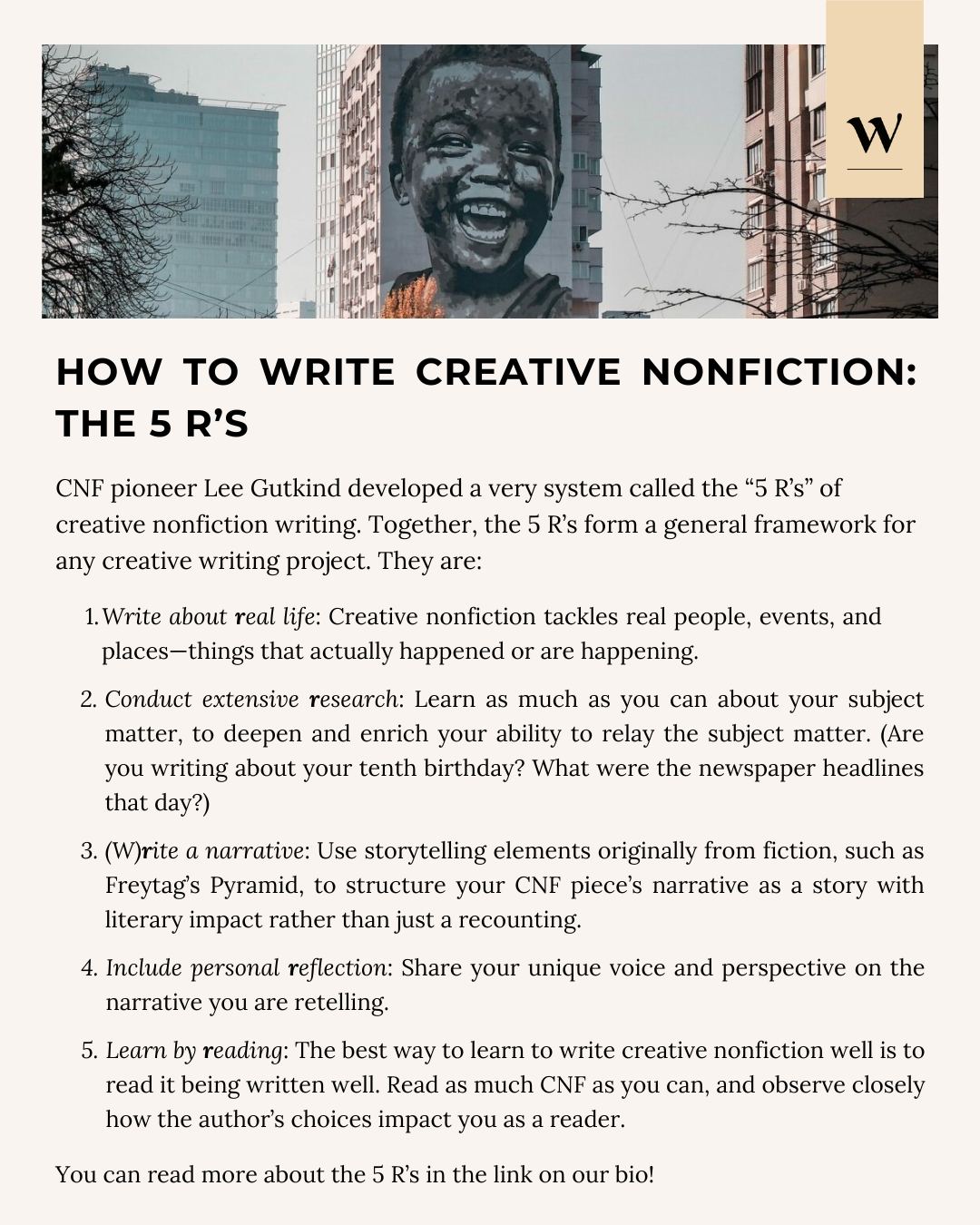
We’re sharing writing tips, creative prompts, and a steady stream of encouragement—follow us @writersdotcom. Click below to check out one of our latest posts on writing creative nonfiction.