Write into the Week: July 5, 2026
Elle LaMarca | July 5, 2026 |
“The isolated imagination is easily corrupted by theory, but the writer inside his community seldom has such a problem.” — Flannery O’Connor
 Dear Writer,
I hope you’re having a good start to your week. In this newsletter:
- A writing prompt to inspire your creativity.
- Reading and listening recommendations in fiction, nonfiction, and poetry.
- Publishing, residency, and retreat opportunities available now.
- Join our free Monday and Friday write-ins, and meet our community of writers.
Happy writing this week!
—Elle, Curriculum Specialist & Instructor
Writer to Writer: Finding Your Writing People
Writing often asks us to spend a great deal of time alone—thinking, drafting, revising, and trying to make sense of the very thing we’re creating through words. While the act of writing is typically done in solitude, a writing life can also be shaped and strengthened by community. At least, mine has been. Some of the most meaningful moments in my writing life have come from the writers, instructors, and readers I’ve met along the way.
Years ago, in the first online writing class I ever took, I was assigned to exchange pages with another writer. At first, we were simply doing what the course required: reading each other’s work, offering feedback, and trying to be useful. We quickly discovered we enjoyed working together so much that when the class ended, we kept going. We continued trading pages, then books, then thoughts about writing and life. Nearly fifteen years later, that early workshop connection has become a real friendship rooted in our shared love of stories. She was the first person to include me in the acknowledgements of a book, an honor that still makes me emotional to think about.
A year after that first online course, I met author and Writers.com instructor Sarah Aronson at a small writing retreat on a farm in Vermont. At the time, neither of us knew we would eventually work together through Writers.com. I only knew that I had met a generous, brilliant writer and teacher who made me feel more serious about my own creative life. Sarah became a mentor to me, and that relationship changed the way I understood writing, teaching, and what it means to be part of a literary community.
I share these stories because writing is so often described as solitary work, and of course, in many ways, it is. No one else can write the sentences for us or sit inside the uncertainty of a draft in quite the same way, but that doesn’t mean we are meant to do all of this alone.
A strong writing community can offer encouragement, accountability, practical advice, and creative companionship that makes the work feel less lonely. Sometimes another writer helps us see what a piece is trying to become long before we realize it ourselves. Sometimes they help us feel seen and secure in the knowledge that frustration, doubt, and slow progress are all normal parts of the creative process. And it is always helpful to have people around us who understand why we care so much about a word, a sentence, or a poem.
I know that sharing early work can be intimidating. Allowing someone to read a messy draft requires trust, and receiving feedback asks us to stay open even when we feel protective of what we’ve created. But when that exchange happens with care, generosity, and respect, it can become one of the most meaningful parts of a writing life. The right readers help us return to our own work with more clarity and understanding.
If you’ve been writing mostly on your own, consider whether it might be time to seek out some form of creative community. That could mean taking a class, attending a retreat, joining a workshop, or finding one trusted critique partner. You never know which connection might become part of your lifelong creative story. Sometimes, the people you meet through writing become one of the reasons you keep writing at all, especially in times of doubt.
Take a moment and ask yourself: What type of creative community might provide the best kind of support to me and my writing?
Writing Prompt: The Person Who Helps You See
Write about a person who helps someone see their work, their life, or themselves more clearly.
This could be a mentor, teacher, friend, critique partner, sibling, stranger, rival, or unexpected guide. The relationship does not need to be simple or sentimental. Maybe this person offers encouragement, or always seems to ask the right questions. Maybe they misunderstand something important, or they challenge the narrator in a way that is uncomfortable yet necessary.
You might write this as a story, essay, poem, scene, or letter. Consider focusing the piece around a moment of exchange. Ideas could be: a conversation, critique, shared silence, piece of advice, or an act of care that changes something.
Literary Device of the Week: Polyphony
Polyphony originally refers to music made from two or more independent melodic lines sounding at the same time. In literature, polyphony describes writing that holds multiple voices, perspectives, or consciousnesses without forcing them into one single, dominant point of view.
A polyphonic piece might include several narrators, braided points of view, overlapping conversations, letters, fragments, documents, or voices from different generations, communities, or versions of the self. What matters is not simply that there are many voices, but that those voices are allowed to remain distinct. They speak beside each other, against each other, and through each other, creating a fuller and more layered understanding than any one voice could offer alone.
For writers, polyphony can be especially useful when exploring families, communities, histories, conflicts, or questions that cannot be answered from only one angle. It reminds us that a story does not always have to move in a single voice to feel unified. Sometimes, meaning emerges from the chorus.
Publishing Opportunities:
- Silly Goose Press – Special Issue Submission Window: July 1-15, 2026. Silly Goose has opened their submissions for two weeks only for a super fun special issue. Per their website: The Sturgeon Moon is set to rise on Thursday, August 27, and we want to leave her an offering. We’re looking for your midnight moonlit mythologies, your odes to the Great Lakes goddesses, your meditations and manifestations, your rites and rituals, and your love letters to the never-topped muse, The Moon. Open to all genres (there’s no one way to worship a Sturgeon Moon after all) and for two weeks only.
- Tupelo Press – Submission Window: July 1-August 31, 2026. Tupelo Press is open for submissions during their summer open reading period. This is not a competition. They will select and publish writing they love. They are open to submissions of full-length and chapbook-length poetry submissions, and they select multiple titles for publication.
- The Drue Heinz Literature Prize – Submissions Open July 1, 2026. The Drue Heinz Literature Prize, awarded by the University of Pittsburg Press, recognizes and supports writers of literary short fiction and makes their work available to readers around the world. The Prize is open to authors who have published at least three short stories or novellas, or one book-length collection of fiction, or a novel. Please see the website for more details, guidelines, and submission requests.
- Poetry International’s Summer Tiny Chapbook Competition – Submission Deadline: September 1, 2026. Submissions are now open for the 2026 Summer Tiny Chapbook competition. They are accepting chapbook submissions of 8-16 pages, any genre. There is a $20 reading fee.
Monday and Friday: Free Group Writing Sessions
Come write with us! Community write-ins are a great way to meet other writers, and carve out space in your calendar for your writing.
Monday: Write Into the Week with Elle
Join me (Elle) for an hour of mindset support, goal setting, community, and dedicated time to write! We’ll meet on Monday at 11 AM Eastern time, at this Zoom link: https://us02web.zoom.us/j/83999379617
Friday: Open Write-In
Join the Writers.com staff for a 90-minute writing session each Friday from 11 AM to 12:30 PM Eastern time. We will write together for the first hour. In the last, optional half hour, we’ll share our writing with one another and connect.
To add yourself, join our newsletter using the join box above, and add yourself to the “Friday Write-Ins” list at the bottom of any email. We’ll send you a Zoom link the morning of the call.
Join us on Instagram for more writing inspiration!
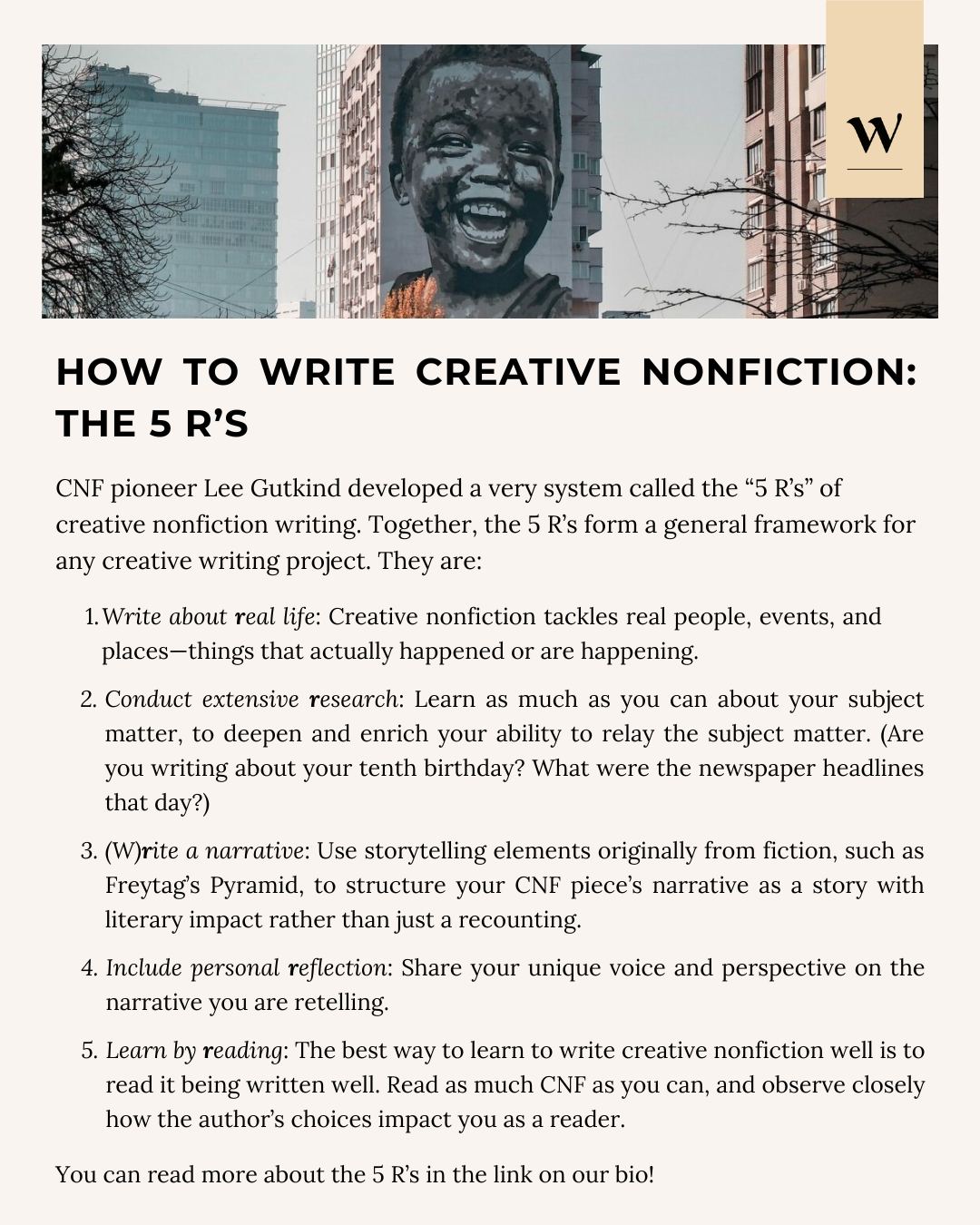
We’re sharing writing tips, creative prompts, and a steady stream of encouragement—follow us @writersdotcom. Click below to check out one of our latest posts on writing creative nonfiction.