Write into the Week: August 9, 2026
Elle LaMarca | August 9, 2026 |
“I think there is a necessity to be still sometimes and let life happen to you, to let your manner of being in the world be changed by what happens to you so that you will have a different self out of which to write.” — Louise Glück
 Dear Writer,
I hope you’re having a good start to your week. In this newsletter:
- A writing prompt to inspire your creativity.
- Reading and listening recommendations in fiction, nonfiction, and poetry.
- Publishing, residency, and retreat opportunities available now.
- Join our free Monday and Friday write-ins, and meet our community of writers.
Happy writing this week!
—Elle, Curriculum Specialist & Instructor
Writer to Writer: The Creative Gift of Boredom
I have officially been living in hotel rooms for a month. Most of my belongings are currently on a boat somewhere between Hawaii and Nebraska, crossing an ocean without me, while I rotate through the small collection of clothes, books, notebooks, and toiletries that could fit into a few suitcases. This is far from my first rodeo. I’ve moved states and countries thirteen times since I turned eighteen, but there is still a strange suspended feeling to this kind of transition. I’m not exactly in my old life anymore, but I’m not fully settled into my new one either. I don’t have my usual desk, my usual bookshelves, or my usual objects arranged around me in any kind of familiar way. What I do have, in surprising abundance, is time and space.
In other words, I’ve been bored.
I don’t mean in the miserable, desperate, or dramatically staring out a rain-streaked window like the heroine of a Gothic novel kind of bored. Just bored in the ordinary, slightly restless way that comes from waiting: waiting for the next hotel check-in, waiting for the movers, waiting for the rest of my life to arrive in boxes. And because boredom is not a feeling many of us are required to experience anymore, I’ve been trying not to rush too quickly to fill it. I’ve been trying (with mixed levels of success) to let some of that empty space remain empty. You read that right—I’m forcing myself to stay bored.
As a child of the eighties and nineties, I am grateful that I grew up before the internet and smartphones, and long before there was always something available to scroll. Childhood boredom was one of the great gifts to my creativity. I didn’t know that at the time, of course. Back then, boredom felt like lying on the floor with nothing to do, staring out car windows and making up stories about the lives of people on the street, and rereading the same books over and over again. All that empty space gave my imagination room to stretch. With nothing constantly rushing in to entertain me, my mind had to generate its own weather: I made up characters. I invented dramas. I turned ordinary moments into whole worlds.
Now, none of us really have to be bored if we don’t want to be. There’s always another post, headline, video, notification. There’s a never ending loop of information to keep our minds occupied. While I love the internet for many reasons, I can also feel what constant input does to my attention. More than that, I can feel what it does to my imagination. Creativity needs room. It needs wandering time. It needs silence, waiting, blankness, and those slightly uncomfortable stretches when nothing obvious is happening. Use it or lose it, as they say. If we never give the imagination space to breathe, we may forget how much it has to say.
I’m trying to think of boredom not as a problem to solve, but as a creative condition worth protecting. If you find yourself with a free hour or two, maybe you’ll join me by not reaching for your phone, laptop or remote control. Instead, let yourself be bored. We do not have to romanticize restlessness to recognize that it can be useful. Sometimes the mind needs to be under-entertained for a while before it remembers how to make something of its own.
Writing Prompt: The Boredom Experiment
This week, I challenge you to open yourself to boredom.
Start by setting aside a small stretch of time to be intentionally bored. Choose twenty minutes, an hour, or an afternoon. Put away your phone, close the laptop, turn off the television, and resist the urge to immediately fill the empty space. You might sit in a chair, look out a window, take a slow walk without headphones, or lie on the floor the way you might have as a child when there was nothing obvious to do.
At first, you may feel restless. Let yourself feel that. Notice where your mind goes when it is not being directed by a screen, a task, or a steady stream of information. What image wanders in? What memory appears? What question keeps circling? What small detail suddenly becomes interesting?
Afterward, write for ten to fifteen minutes about whatever surfaced. You do not need to turn it into anything polished right away. Begin with the boredom itself, or with the first strange thought, memory, sentence, or image that arrived once you stopped trying to be entertained.
Let your imagination remember what it can do with a little empty space.
Reading Recommendations
Poetry:
- “#549. Why Do Drops of Water Flatten and Disappear after a Time?” by Anastasia Stelse via Narrative Magazine. Stelse’s poem is an excellent example of the use of white space, text arrangement and metaphor to strengthen the depth and meaning of a heartfelt poem.
Fiction:
- “A Chain of Tiny Disasters” by Rebecca McKanna via Narrative Magazine. Some a great opening sentence pulls you in at the start, only to repel you at the end–and that is how this short story by McKanna begins. Follow the “chain of tiny disasters” of two sisters traveling across Italy.
Nonfiction:
- “180 Sumac” by Julia Scheeres via Narrative Magazine. In this personal essay, Scheeres memorializes her brother, who died in an accident far too young, by returning to their childhood home at 180 Sumac.
Listening Recommendations
- From How to Write for a Living podcast – “416: An honest look at what literary agents actually want (with Louise Buckley” – In this episode, literary agent Louise Buckley draws on her experience as a bookseller, editor, and agent to demystify the traditional publishing process. She offers a refreshingly honest look at submissions, query letters, platform expectations, and why even a manuscript an editor loves may still face hurdles on the path to publication.
- From the Interesting People Reading Poetry podcast – “Novelist Lisa Ko Reads Tracy K. Smith” – In this episode, novelist Lisa Ko reads Tracy K. Smith’s “Don’t You Wonder, Sometimes?,” a poem from Smith’s Pulitzer Prize-winning collection Life on Mars. The pairing offers a rich literary moment between two writers whose work considers art, identity, memory, and what it means to remain awake to the strange pressures of contemporary life.
Publishing Opportunities:
- Gulf Coast Journal – Submission Deadline: Various, see website. The Gulf Coast Journal is currently open for submissions for the following special events: the Gulf Coast Prize in Translation, the Toni Beauchamp Prize in Critical Art Writing, and the Barthelme Prize for Short Prose. Please review the website for specific guidelines for each.
- Michigan Quarterly Review – Submission Deadline: October 1, 2026. The Michigan Quarterly Review is now open for general submissions of prose and poetry. They are also accepting submissions for a special folio on basketball. Please see the website for submission guidelines and details.
- The Hope Prize Short Story Competition – Submission Window: June 1-October 1, 2026. The Hope Prize is a global short story competition open to writers from anywhere in the world. Stories can be on any genre or topic, but must be written in prose, and be a maximum of 5,000 words.
- Louise Glück Prize for Best Poem or Prose – Submission Window: Open. Poetries in English Magazine is currently accepting submissions for the inaugural Louise Glück Prize for Best Poem or Prose prize. The winner will receive publication in the magazine and a $1000 award. All submissions will be considered for publication.
Monday and Friday: Free Group Writing Sessions
Come write with us! Community write-ins are a great way to meet other writers, and carve out space in your calendar for your writing.
Monday: Write Into the Week with Elle
Join me (Elle) for an hour of mindset support, goal setting, community, and dedicated time to write! We’ll meet on Monday at 11 AM Eastern time, at this Zoom link: https://us02web.zoom.us/j/83999379617
Friday: Open Write-In
Join the Writers.com staff for a 90-minute writing session each Friday from 11 AM to 12:30 PM Eastern time. We will write together for the first hour. In the last, optional half hour, we’ll share our writing with one another and connect.
To add yourself, join our newsletter using the join box above, and add yourself to the “Friday Write-Ins” list at the bottom of any email. We’ll send you a Zoom link the morning of the call.
Join us on Instagram for more writing inspiration!
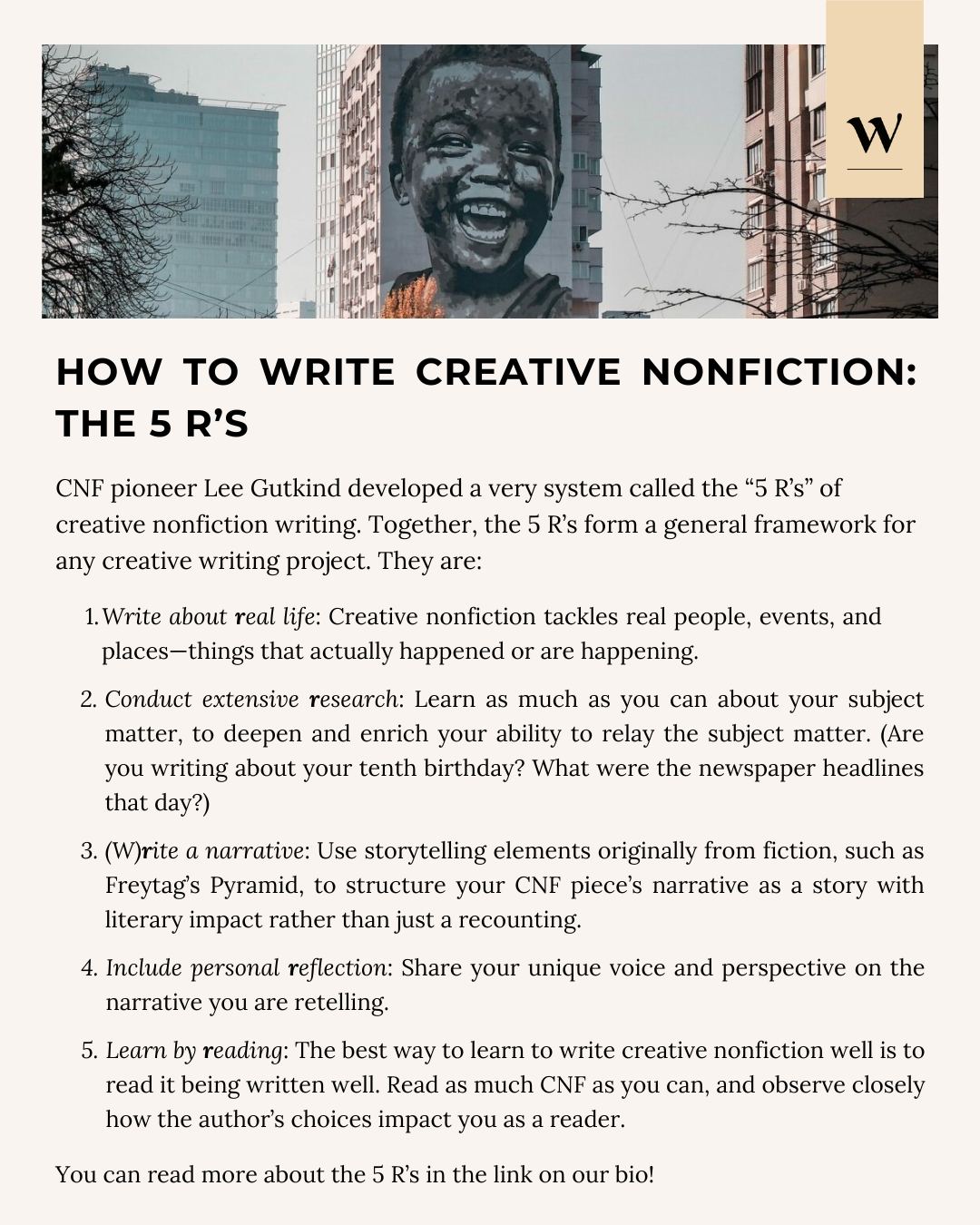
We’re sharing writing tips, creative prompts, and a steady stream of encouragement—follow us @writersdotcom. Click below to check out one of our latest posts on writing creative nonfiction.