Write into the Week: August 16, 2026
Elle LaMarca | August 16, 2026 |
“The true alchemists do not change lead into gold; they change the world into words.” — William H. Gass
 Dear Writer,
I hope you’re having a good start to your week. In this newsletter:
- A writing prompt to inspire your creativity.
- Reading and listening recommendations in fiction, nonfiction, and poetry.
- Publishing, residency, and retreat opportunities available now.
- Join our free Monday and Friday write-ins, and meet our community of writers.
Happy writing this week!
—Elle, Curriculum Specialist & Instructor
Writer to Writer: Process & Patience
Patience may be a virtue, but it can be a difficult one to practice when we’re making art. If you’re anything like me, you may find yourself growing impatient with the writing process. Sometimes, we place too many expectations on our work long before it has had the chance to reveal itself. We ask our writing to become successful before we’ve allowed it to simply become.
If the above resonates with you, don’t be too hard on yourself. We live in a world that loves visible progress, clear milestones, and finished products. Writers and artists are not exempt from needing external proof that what we’re doing matters. But writing rarely moves in such a clean, efficient line. A poem may need time to become itself; a novel may need hundreds of uncertain pages before the writer understands what it is really about; and a personal essay may begin with one question and end somewhere the writer could not have predicted.
In my work with writers, I often see how impatience can pull people out of the creative process too soon. A writer may worry about finding an agent before they’ve reached the middle of a first novel draft. Another may start thinking about book sales before they’ve ever written “The End.” A poet may throw away a draft before giving it enough space to breathe in revision. Someone writing a personal essay may decide, halfway through, that their story isn’t interesting enough for *The New York Times*, and so why bother finishing it at all?
I understand this impulse.
Most writers are not impatient because they don’t care about the work. They are impatient because they care so much. They want the piece to matter. They want to know where it belongs—to feel that the time, effort, and emotional risk will lead somewhere. But when we rush too quickly toward publication, recognition, or some imagined future version of success, we can lose contact with the actual art, which is happening right now, sentence by sentence, choice by choice, revision by revision.
The process is not just the long hallway we have to walk through in order to reach the finished product. The process is where the art is made. It’s where we discover what we mean, fear, notice, and what we are trying to understand. The process is where an image sharpens, a character surprises, a line breaks open, or an essay reveals a deeper truth than the one we thought we were writing toward. If we only value the work once it becomes finished, published, praised, or validated, we miss so much of what writing has already given us.
Whenever you’re feeling hurried with the process of writing, I encourage you to practice a little patience with whatever stage of a draft you’re in. Let it be unfinished; let it breathe; let it become.
Remember, the process is the art, not the product.
Writing Prompt: Fresh Eyes
This week’s challenge is to return to an old draft—poem, essay, story, etc—you once gave up on, grew tired of, or decided wasn’t working. Do your best to read it with curiosity instead of judgment.
Focus on what you admire about the piece, instead of what you think still isn’t working. Highlight the words, images or sentences that still stir the writer inside of you. Then, rather than trying to fix the whole piece, choose that small spark and write forward from there. Give the draft a chance to become something new. Surprise yourself.
Reads on Writing
- “How Should Debut Novelists Measure Success?” by K.E. Semmel via The Millions – This essay looks honestly at the pressure debut novelists face to define success through sales, visibility, and industry momentum. By speaking with recently debuted authors, it offers a more grounded look at what writers can control, what they can’t, and how success might be measured beyond the fantasy of a major launch.
- “The Nearly Departed: Inside the Art of Writing a Great Obituary” by Sam Roberts via Lit Hub – After decades of writing advance obituaries for The New York Times, Sam Roberts offers his perspective on writing about the almost-dead, and what to consider and include when writing an obituary.
- “Sestina Poetry: How to Write a Sestina Poem” by Sean Glatch via Writers.com. For a brief period in college, I was obsessed with writing sestina poems. In this article, Glatch does a wonderful job of explaining the form, offers tips on how to craft a sestina, and offers several examples.
Wordy Facts: Kangaroo Words
Merriam-Webster has a fabulous social media account. It’s full of word play, grammar jokes, and interesting etomolgy. This week I came across a post about kangaroo words. If you’ve never heard of this before, a ‘kangaroo word’ is a word that contains all of the letters of one of its synonyms, in order. So, it’s essentially carrying the other word inside of it.
For example, “observe” carries the word “see” and “encourage” carries the word “urge.” (So fun!) The word inside of the kangaroo word is called a “joey word.” (Even funner!) Here are a few other examples: Charisma carries charm, masculine carries male, chicken carries hen, fragile carries frail.
I’d heard of kangaroo words before, but it had been a long time since I’d thought of them. Merriam-Webster did teach me that “grand kangaroos” have a joey within a joey. For example, “alone” contains “lone” which contains “one.” And an “anti-kangaroo” contains a joey that is an antonym rather than a synonym, like how “covert” contains “overt.”
Publishing Opportunities:
- Gulf Coast Journal – Submission Deadline: Various, see website. The Gulf Coast Journal is currently open for submissions for the following special events: the Gulf Coast Prize in Translation, the Toni Beauchamp Prize in Critical Art Writing, and the Barthelme Prize for Short Prose. Please review the website for specific guidelines for each.
- Michigan Quarterly Review – Submission Deadline: October 1, 2026. The Michigan Quarterly Review is now open for general submissions of prose and poetry. They are also accepting submissions for a special folio on basketball. Please see the website for submission guidelines and details.
Residencies, Retreats & Fellowships
- Storyknife Writers Retreat – Application Deadline: August 31, 2026. Apply to spend two or 4 weeks living and writing in your own private cabin. You’ll be served delicous meals, have focused writing time, and live amongst a cohort of other talented writers. Storyknife is open to women writers only, and takes place in Homer Alaska. There mission “is to give women writers the time and space to explore their craft without distraction.”
- Nightboat Books Editorial Fellowship – Applicatin Deadline: September 13, 2026. Nightboat’s Editorial Fellowship is designed to provide an aspiring editor with $10,000, along with the resources and mentorship necessary to develop and publish a book project of their choosing over the course of two years. Note: This fellowship is for aspiring editors. See the website for further details.
- Vermont Studio Center Residency – Application Deadline: September 30, 2026. Residency applications are now open for the Vermont Studio Center. Artists and writers in all forms and genres are welcome to apply for residencies happening from July to December 2027. All residents receive partial fellowship, and 35% receive fully funded fellowships.
Monday and Friday: Free Group Writing Sessions
Come write with us! Community write-ins are a great way to meet other writers, and carve out space in your calendar for your writing.
Monday: Write Into the Week with Elle
Join me (Elle) for an hour of mindset support, goal setting, community, and dedicated time to write! We’ll meet on Monday at 11 AM Eastern time, at this Zoom link: https://us02web.zoom.us/j/83999379617
Friday: Open Write-In
Join the Writers.com staff for a 90-minute writing session each Friday from 11 AM to 12:30 PM Eastern time. We will write together for the first hour. In the last, optional half hour, we’ll share our writing with one another and connect.
To add yourself, join our newsletter using the join box above, and add yourself to the “Friday Write-Ins” list at the bottom of any email. We’ll send you a Zoom link the morning of the call.
Join us on Instagram for more writing inspiration!
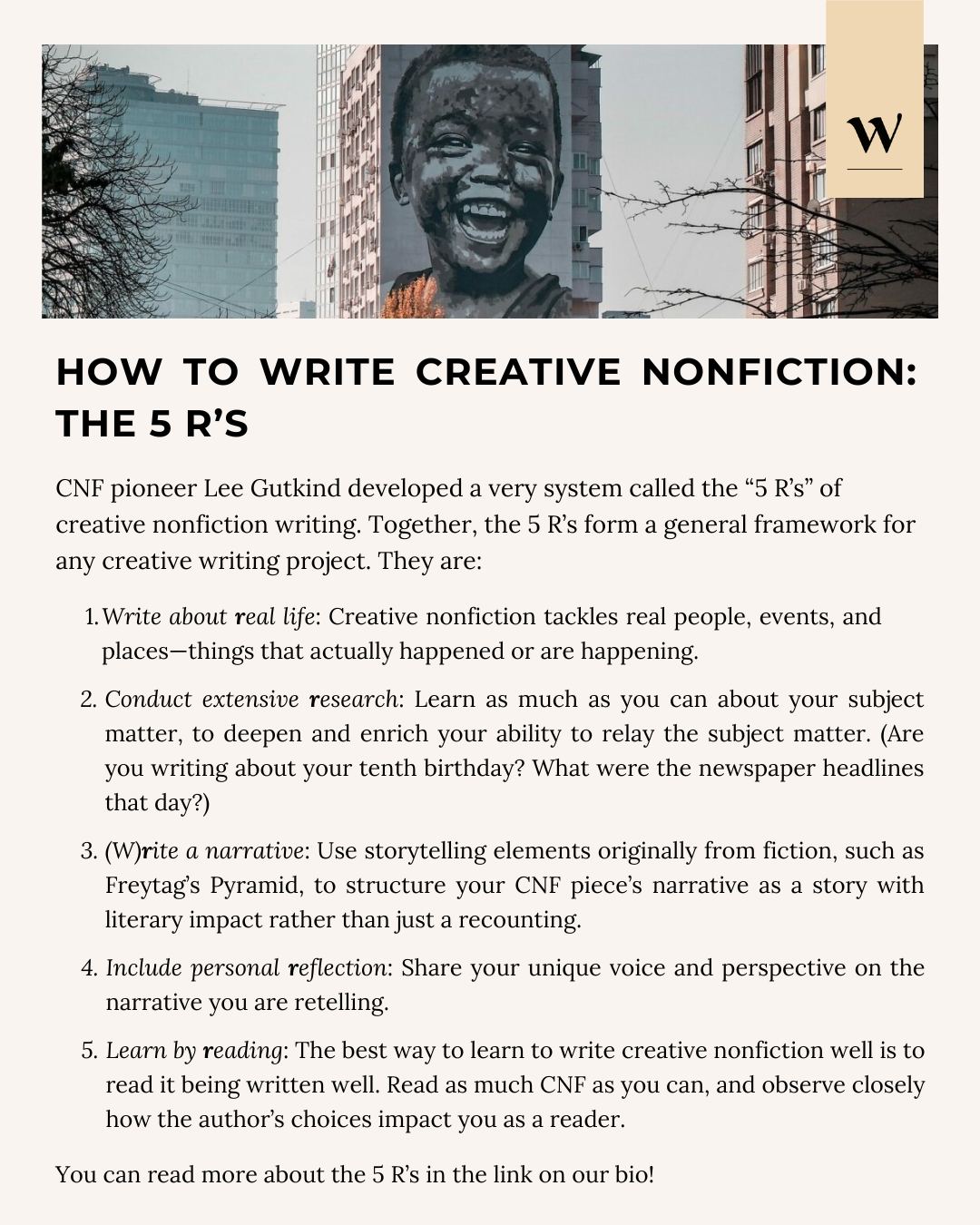
We’re sharing writing tips, creative prompts, and a steady stream of encouragement—follow us @writersdotcom. Click below to check out one of our latest posts on writing creative nonfiction.