Write into the Week: September 20, 2026
Elle LaMarca | September 20, 2026 |
“The writer must believe that what he is doing is the most important thing in the world. And he must hold to this illusion even when he knows it is not true.” — John Steinbeck
 Dear Writer,
I hope you’re having a good start to your week. In this newsletter:
- A writing prompt to inspire your creativity.
- Reading and listening recommendations in fiction, nonfiction, and poetry.
- Publishing, residency, and retreat opportunities available now.
- Join our free Monday and Friday write-ins, and meet our community of writers.
Happy writing this week!
—Elle, Curriculum Specialist & Instructor
Advice I Return To: Follow the Heat
When a draft feels flat, uncertain, or messy beyond repair, I remind myself to pause and consider all of the great advice I’ve received from writing mentors over the years. One offering I’ve heard repeatedly, from several sources and in various forms, is to follow the heat—or the heartbeat.
The “heat” is the part of the piece that has the most energy, the part that seems to pulse right on the page. It might be the image at the center of a scene, a sentence with an unusual rhythm, or a moment of intense tension between two characters. If you’re lucky, sometimes it’s the part of a draft that feels easiest to write, but often, it’s the part that makes you nervous and challenges you most.
Following the heat means paying attention to where your writing seems most charged, even if that place is not where you expected the piece to go. You might just have to give up control and follow the flames. A draft may begin as one thing, but later reveal that its real energy lives somewhere unexpected. When that happens, resist the urge to course correct, at least at first. Remember, you’re drafting. Now is the moment for play and experimentation. Stay with the image, scene, sentence, or question that seems to be asking for more. Allow the piece to show you what it wants to become, instead of forcing it into what you expected from it.
Writer’s Tool of the Week: The Opening Question
Before you begin a new piece, or when you feel blocked from moving forward while drafting, try asking yourself: What question is this piece trying to answer?
This does not need to be (and rarely should be!) a literal question that appears on the page. In fiction, those questions might be: What does this character want but refuse to admit? What happened in this family that no one talks about? What would change if the secret came out? In memoir or personal essay, you might ask: Why do I keep returning to this specific memory? What am I still trying to understand? What part of this experience has not settled yet? In a poem, the question might be quieter or more mysterious: What is this image trying to reveal? What does the speaker know or not know? What feeling am I circling? What can language reveal that explanation cannot?
I am not saying that you should know the answer before you begin. Honestly, the writing often becomes more interesting when you don’t, and your answers will likely change as you draft and revise. The question simply gives you something to focus on while allowing the piece a direction to move toward. Remember that writing is not only a way to say what you already know, but a way to discover what you are trying to know. And always, always, a way to explore.
Writing Prompt: The Last Question
What’s the last serious question someone asked you? Did you tell the truth or did you lie?
Write two short pieces. In the first, tell the truth. In the second, lie. What happens? What changes? What’s better or worse? Is honesty always the best option?
I encourage you to play around with this prompt—experiment with form, genre, and length.
Reading Recommendations: Substack Edition
I enjoy perusing Substack for great writing, and great writing about about writing. Here are three of my favorite recent reads:
- “The Memoir Land Author Questionnaire 241: Carla Lalli” via The Lit Lab Substack. An incredibly honest and insightful interview with writer Carla Lalli. Lalli is author of Food is Feeling, which “is a genre-expanding cookbook memoir that combines personal essays and recipes. Rooted in her experiences as a cook, a parent, and a recently divorced person, it explores the emotional connections between cooking, eating, and feeding others.”
- “French Connection” by Joe Giordano via the After Dinner Conversation Substack. “Would you trust the advice of a historical figure when making big decisions?” is the question at the heart of this flash fiction piece, where ‘a college student is transported back to Paris to have coffee with Simone de Beauvoir, Jean Paul Sartre, and Albert Camus.”
- “Detail with a Pulse to Make Your Writing Sing” by Estelle Erasmus via the Writing that Gets Noticed Substack. Erasmus gets deep about the importance of depth in description. I particularly like that she focused on the need for specificity—something I recommend to writers frequently. Universal resonance is often found in the finer details.
Listening Recommendations
- From The Poetry Space podcast – “Prufrock Part 1: T.S. Eliot’s ‘The Love Song of J. Alfred Prufrock'” – T.S. Eliot was 22 when he drafted it, 26 when Ezra Pound finally strong-armed it into print, and the first edition took five years to sell 500 copies. In this episode, the hosts walk “The Love Song of J. Alfred Prufrock” from that etherized evening sky down to the ragged claws—Dante’s epigraph, the yellow fog that’s a cat, the coffee spoons, and the overwhelming question nobody ever asks.
- From The New Yorker: The Writer’s Voice podcast – “Sarah Anderson Reads ‘Dark Horse'” – Sarah Anderson reads her story “Dark Horse,” from the September 28, 2026, issue of The New Yorker. Anderson is a graduate of the Helen Zell Writers’ Program at the University of Michigan, where she won two Hopwood Awards. Her début novel, “Fallow,” was published in September 2027.
Publishing Opportunities:
- The Kenyon Review – Submission Deadline: September 30, 2026. Currently open for general submissions in short fiction, flash fiction and essays, poetry, and excerpts from larger works, and translation.
- Electric Literature – Submission Window: Septembeer 28-Ocotber 11, 2026. Electric Lit’s submission window for personal narrative essays opens this week! Submissions will remain open until October 11th or until they receive 500 submissions—which ever comes first. Don’t delay! (Note: Submissions won’t open until the 28th!)
- New Plains Review Contest – Submission Deadline: October 13, 2026. $1,000 prize for poetry and fiction. They are specifically interested in work focused on water. Please see the guidelines on their Submittable page for more details.
- Chrysalis Journal – Submission Deadline: November 30, 2026. Chrysalis is a bilingual literary and visual arts journal. They are currently open to submissions of art, poetry, fiction and nonfiction in both English and Spanish.
Residencies, Retreats & Fellowships
- Vermont Studio Center Residency – Application Deadline: September 30, 2026. Residency applications are now open for the Vermont Studio Center. Artists and writers in all forms and genres are welcome to apply for residencies happening from July to December 2027. All residents receive partial fellowship, and 35% receive fully funded fellowships.
- Lighthouse Works Fellowship – Application Deadline: October 1, 2026. Lighthouse Works offers six-week, year-round fellowships for cultural producers, with housing, food, private studio space, and $1,750 in financial support. Fellows stay in a shared Victorian house, gather for staff-cooked dinners most nights, and work in private, light-filled studios facing the ocean near Silver Eel Cove, with access to a wood and metal fabrication shop and kiln. The residency is designed to give fellows time and space to focus on their work, while an Artist Talk and Open Studio create opportunities for conversation, critique, and connection.
- Djerassi Resident Artists Program – Application Deadline: October 9, 2026. Applications for 2027 residencies are now open! The Djerassi Resident Artist Program has awarded over 2700 writers, visual/media artists, composers, choreographers, filmmakers and scientists for the past 42-years the gift of time and space with a one-month residency on their 583-acre ranch in Northern California’s Santa Cruz Mountains. All at no cost to the artists. (Elle has attended multiple residencies there, and she highly encourages you to apply!)
Monday and Friday: Free Group Writing Sessions
Come write with us! Community write-ins are a great way to meet other writers, and carve out space in your calendar for your writing.
Monday: Write Into the Week with Elle
Join me (Elle) for an hour of mindset support, goal setting, community, and dedicated time to write! We’ll meet on Monday at 11 AM Eastern time, at this Zoom link: https://us02web.zoom.us/j/83999379617
Friday: Open Write-In
Join the Writers.com staff for a 90-minute writing session each Friday from 11 AM to 12:30 PM Eastern time. We will write together for the first hour. In the last, optional half hour, we’ll share our writing with one another and connect.
To add yourself, join our newsletter using the join box above, and add yourself to the “Friday Write-Ins” list at the bottom of any email. We’ll send you a Zoom link the morning of the call.
Join us on Instagram for more writing inspiration!
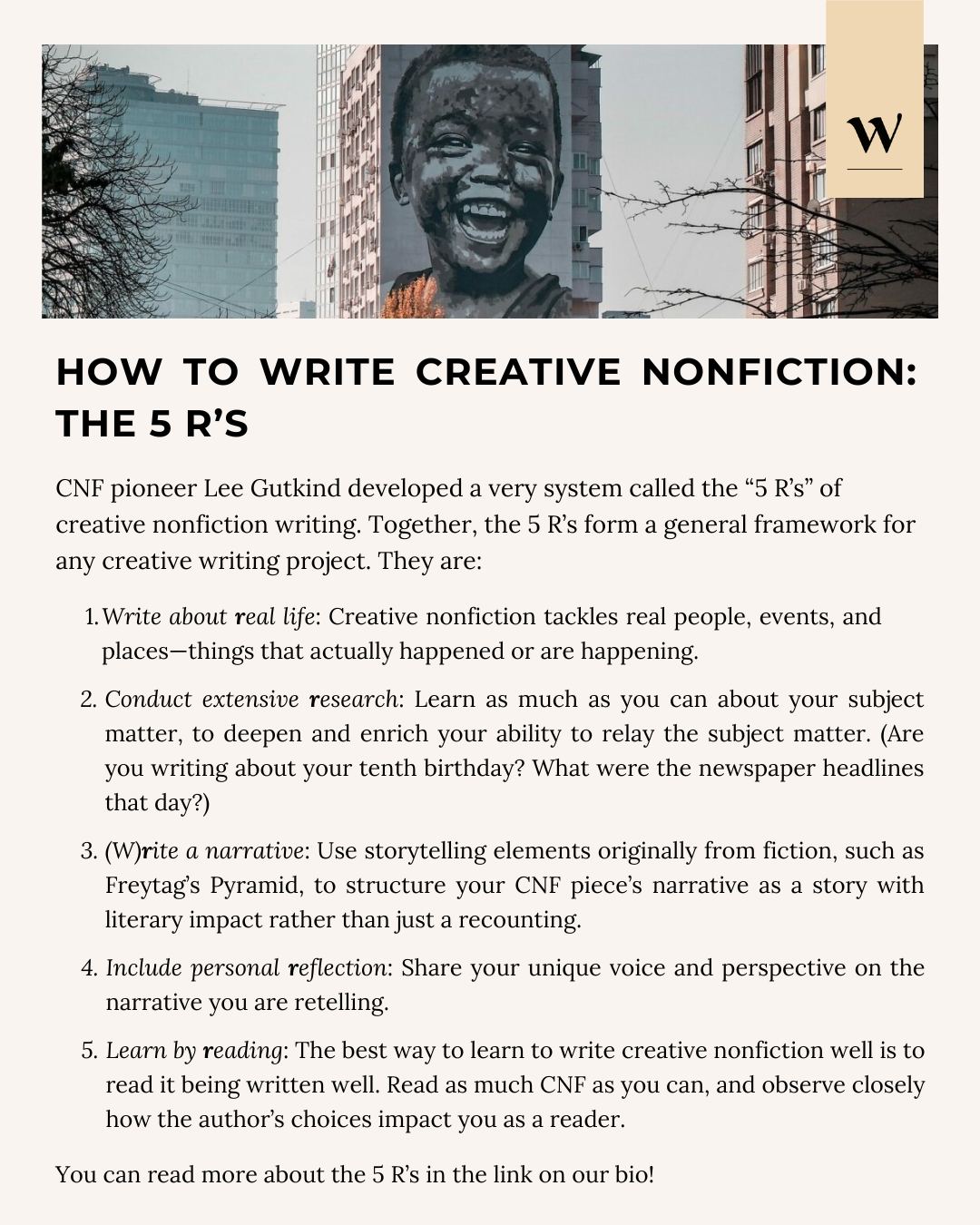
We’re sharing writing tips, creative prompts, and a steady stream of encouragement—follow us @writersdotcom. Click below to check out one of our latest posts on writing creative nonfiction.