Write into the Week: October 18, 2026
Elle LaMarca | October 18, 2026 |
“October is a symphony of permanence and change.” — Bonaro W. Overstreet
 Dear Writer,
I hope you’re having a good start to your week. In this newsletter:
- A writing prompt to inspire your creativity.
- Reading and listening recommendations in fiction, nonfiction, and poetry.
- Publishing, residency, and retreat opportunities available now.
- Join our free Monday and Friday write-ins, and meet our community of writers.
Happy writing this week!
—Elle, Curriculum Specialist & Instructor
Writer to Writer: What the Writer Needs
I just finished teaching another session of my Creative Mindset for Storytellers course, and one of the things I love most about this work is how different every writer who takes the course can be. As a creative mindset instructor and coach, much of what I focus on, and ask writers to focus on, happens away from the page. I help writers think about creative confidence, expectations, habits, comparison, motivation, burnout, and all the other things that affect whether we can build a sustainable, long-term relationship with writing. I sometimes think of it simply as supporting the writer off the page so the writer can do the work on the page.
In this particular group, one writer was working toward finishing a novel. Another had been a professional writer for years and was trying to reconnect with the work in a way that felt meaningful again. Someone else was taking up writing in retirement and brought the wonderfully eager curiosity of a person discovering a new creative life. One participant attended the first class, realized the course itself wasn’t quite what she needed, and instead asked if I would work with her privately. I loved that, too. She recognized what kind of support would actually serve her and asked for it. Figuring out the right kind of support at the right moments within the creative process is part of the very foundation of creative mindset.
Seeing all of these writers together reminded me how little sense it makes to imagine that there is one correct way to have a writing life. Another foundation of creative mindset is understanding that the process is different for everyone, and the key is learning the unique process that is right for you rather than emulating anyone else’s. Writers enter the work at different ages and stages, carrying different experiences, ambitions, fears, responsibilities, and definitions of success. What supports a writer trying to finish a first novel may be completely different from what a longtime professional needs to rediscover joy in the work. And what we ourselves need may change from one year—or even one project—to the next. What often harms us is expecting every day of writing to look like our very best day of writing, or believing that our needs, output, and goals should always remain the same.
In my very humble opinion, sustaining a creative practice has less to do with finding the perfect routine and much (much!) more to do with learning how to pay attention to ourselves and listen to our creative needs. Where are you right now in your writing life? What feels difficult? What feels exciting? What kind of support would make it easier to keep going?
There is no prize for needing less help, figuring everything out alone, or following someone else’s version of a successful writing life. The goal is to build a creative practice that can grow and change alongside you. Sure, sometimes that means discipline and simply getting the words on the page. Other times, it means community, encouragement, rest, accountability, instruction, or permission to find new ways to begin again. Remember: as the writer changes, the creative process and the support we need must be allowed to change, too.
Writing Prompt: What the Work Needs
Write a piece in which an unfinished creation of any kind—a novel, painting, garden, invention, meal, or something completely different—can tell its creator what it needs. The creator may agree, resist, misunderstand, or discover that the creation wants (and needs) something entirely different from what they planned.
This can take any form: poem, essay, flash fiction or short story. It can be the whole piece, or it can be just a portion. Explore, play, and listen to what the work needs.
Tiny Truths: Your Process Is Allowed to Change
What helps you write now may not be what helped you write five years ago—or even five months ago. Our lives change, our projects change, and we change, too.
A sustainable creative practice has to be flexible enough to evolve with us. Sometimes growth means recognizing when a process has carried you as far as it can. You’re allowed to meet yourself where you are now and build from there.
A Closer Look: Great First Lines
“Ships at a distance have every man’s wish on board.” —Zora Neale Hurston, Their Eyes Were Watching God
Some opening lines pull us into a story; others seem to contain a whole philosophy before the story has even begun—Hurston’s does both. The image of ships waiting on the horizon turns desire into something visible. Our wishes are out there somewhere, distant enough that we can imagine what they might bring us, but not close enough that we have to yet deny reality.
The sentence has the compact confidence of an aphorism. It feels less like setup, and more like a piece of wisdom the novel is asking us to carry forward.
The line becomes even more interesting in the sentences that follow, when Hurston begins distinguishing between the dreams of men and women. What initially sounds like a universal statement about longing becomes the beginning of a larger examination of who gets to pursue desire, who waits for it to arrive, and what happens when our dreams collide with reality. For the protagonist, Janie, those questions will become central as she learns to separate the life others imagine for her from the one she wants for herself. The distant ship also introduces the image of the horizon, which carries meaning throughout the novel as Janie’s understanding of herself and the possibilities of her life expand.
For writers, this opening is a wonderful example of how one concrete image can do several jobs at once: create curiosity, establish theme, introduce symbolism, and give the reader an idea large enough to carry into the story ahead.
Publishing Opportunities:
- Split/Lip Press – Submission Deadline: December 1, 2026. Currently open for creative nonfiction manuscript submissions, including essay collections, memoir, and hybrid work. Must be at least 125 pages. Split/Lip Press publishes innovative and culturally relevant books. They are dedicated to publishing boundary-breaking books. Does that sound like yours?
- The Neilma Sidney Short Story Prize – Submission Deadline: December 4, 2026. Supported by the Malcolm Robertson Foundation, Overland literary journal is currently accepting submissions for the 2026 Neilma Sidney Short Story Prize. The winner will receive a $5000 cash prize and publication. Two runners-up will each receive $750. Please see the website for more details.
- The Judith Wright Poetry Prize – Submission Deadline: December 4, 2026. Supported by the Malcolm Robertson Foundation, Overland literary journal is currently accepting submissions for the 2026 Judith Wright Poetry Prize is now open for submissions. First prize is $6000, second prize is $2000, and third prize is $1000.
- Room Magazine’s Short Forms Contest – Submission Deadline: December 15, 2026. Room is hosting their annual contest for Short Forms. Your entry can be in any genre up to 500 words: one or two prose poems, flash fictions, flash creative non-fictions, or hybrid pieces. Apply ASAP as they close for submission when they meet their cap, even if it’s before the deadline!
Monday and Friday: Free Group Writing Sessions
Come write with us! Community write-ins are a great way to meet other writers, and carve out space in your calendar for your writing.
Monday: Write Into the Week with Elle
Join me (Elle) for an hour of mindset support, goal setting, community, and dedicated time to write! We’ll meet on Monday at 11 AM Eastern time, at this Zoom link: https://us02web.zoom.us/j/83999379617
Friday: Open Write-In
Join the Writers.com staff for a 90-minute writing session each Friday from 11 AM to 12:30 PM Eastern time. We will write together for the first hour. In the last, optional half hour, we’ll share our writing with one another and connect.
To add yourself, join our newsletter using the join box above, and add yourself to the “Friday Write-Ins” list at the bottom of any email. We’ll send you a Zoom link the morning of the call.
Join us on Instagram for more writing inspiration!
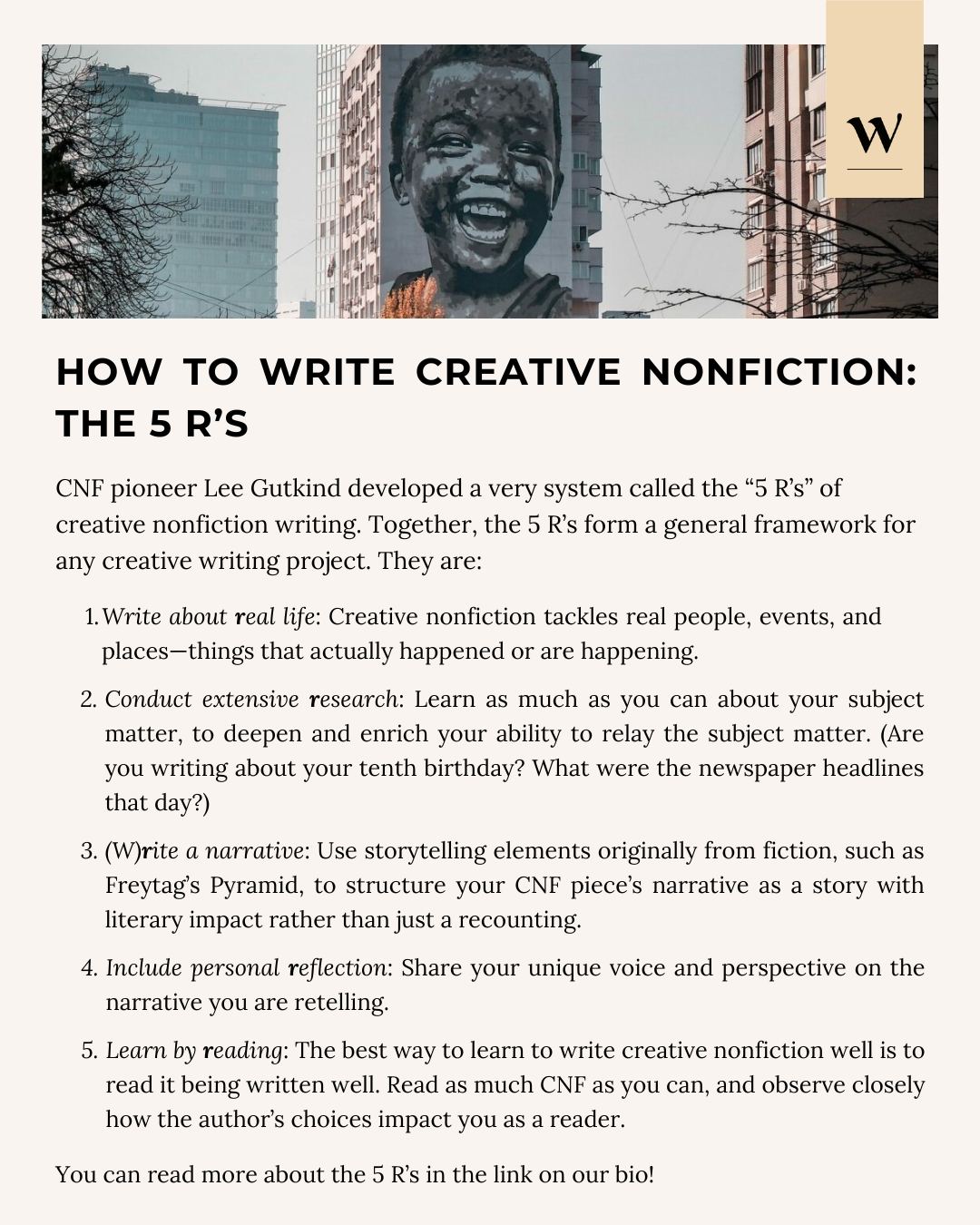
We’re sharing writing tips, creative prompts, and a steady stream of encouragement—follow us @writersdotcom. Click below to check out one of our latest posts on writing creative nonfiction.