Write into the Week: June 14, 2026
Elle LaMarca | June 14, 2026 |
“Half my life is an act of revision.”
–John Irving
 Dear Writer,
I hope you’re having a good start to your week. In this newsletter:
- A writing prompt to inspire your creativity.
- Reading and listening recommendations in fiction, nonfiction, and poetry.
- Publishing, residency, and retreat opportunities available now.
- Join our free Monday and Friday write-ins, and meet our community of writers.
Happy writing this week!
—Elle, Curriculum Specialist & Community Manager
Writer to Writer: An Archaeologist of Words
I spend a lot of time writing, and a lot of time thinking about the act of writing and about writers themselves. This week, I spent some time considering just how much material we writers collect before we have any idea what we’re going to do with it. I like to think of myself as an archaeologist of words, out here collecting everything that interests me: fragments, images, overheard lines, odd little details, words I’ve never heard before, and questions I don’t know the answers to yet.
But unlike archaeologists, writers aren’t always cataloging our discoveries in neat little drawers. Yes, notebooks and files have their place. Many of us keep some version of a “fragments” document, where we save possible titles, interesting facts, strange images, or ideas that haven’t found a home in our writing just yet. I also think there’s a deeper collecting that often happens quietly, long before we make the conscious decision to write something down. A conversation we overhear in a grocery store might stay with us for years. A story told at a family dinner thirty years ago leaves behind one oddly specific detail. Something a teacher said to you in the eighth grade pops into your mind at strange times, asking for attention even though we don’t yet understand why.
I’ve always been curious about what makes certain things linger. It’s strange, isn’t it? How we forget so much of what happens to us, and yet some moments remain intact. We may forget entire days, months, even seasons of our lives, but still remember the expression on a stranger’s face in an airport, or a sentence from a book whose plot has otherwise disappeared from memory. There’s something mysterious about the way the mind chooses what to keep.
For writers, I think this kind of gathering is part of the work, even when it doesn’t look like work. We are constantly absorbing the world around us, not in a neat or organized way, but in fragments that may not make sense for years. I recently wrote an essay after a memory from middle school returned to me while reading an article in The Atlantic. It was a delightfully inspired surprise, as I hadn’t thought about that memory for decades and had no plans of writing that particular essay. But the material was there, hanging out someplace in my mind, waiting for me.
That’s what I find reassuring. Writing does not only happen when we are actively drafting. The drafting matters, of course, but so does the long, strange accumulation that comes before it. Every conversation, book, place, relationship, and passing curiosity becomes part of what we carry. I like to think of all of this as our personal source material. We don’t always know what will become useful. We don’t always know why something stays or hides out for a while.
So if you’re worried that you haven’t been writing enough, consider the possibility that you may be in a gathering phase. Paying attention to the world, noticing what lingers, and trusting your curiosity are all part of the work. Writers have a remarkable habit of saving things before they know why they’re worth saving. Trust that what stays with you is staying for a reason. Trust that your process will reveal itself.
Writing Prompt: Opposites Attract
Write a piece in which the driving forces are opposites. Think good and evil, hot and cold, smooth and rough, light and dark, certainty and doubt, belonging and loneliness.
The opposites can exist within a character, between two people, within a setting, or inside of a single memory. Rather than choosing one side over the other, allow both to exist on the page at the same time. What tension emerges when seemingly contradictory forces occupy the same space?
Reading Recommendations
Creative Nonfiction
- “HOW TO F/HOLD ON TO YOUR HUMANITY” by Rayya Liebich via Room Magazine. In a world shaped by profound injustice, how do we create amidst unrest while reclaiming rest that moves us toward justice? Liebich answers this question in a unique piece that includes a step-by-step guide.
Poetry
- The Post Office: An Opera in Poems by Elaine Sexton via Poetry International. Read four poems from Sexton’s latest collection, and learn more about the inspiration for the book and her work.
Fiction
- “Lilah Around Town” by K.Y. Agbayani via Room Magazine. Agbayani explore existential crisis, states of emergency, and our personal roles within them.
Listening Recommendations
- From the Always Take Notes Podcast – “Kathryn Stockett on the success (and controversy) of The Help and taking 17 years to publish a follow-up novel, The Calamity Club” – If you’ve ever wondered what happens after a debut novel becomes a global phenomenon, this conversation offers a fascinating look behind the curtain. Kathryn Stockett discusses the unexpected success of The Help, her years working in publishing, and the long, often difficult road to completing and publishing her follow-up novel more than a decade later.
- From the Memoir Nation Podcast – “Eleni Sikelianos on How Subject Shapes Story” – This episode offers a fascinating look at the relationship between content and form, challenging the idea that a writer must choose a structure before beginning a project. Through a discussion of memoir, family history, and photographs as storytelling tools, Eleni Sikelianos explores how a piece can discover its own shape as it unfolds.
Publishing Opportunities:
- Room Magazine’s 2026 Non-Fiction Contest – Submission Deadline: June 30, 2026. Room has extended the submission deadline for their 2026 Non-fiction contest! Entries are judged by writer, Kai Cheng Thom. First prize is $1,000! They are accepting submission of nonfiction pieces up to 3,500 words.
- Electric Literature’s Emerging Writers Contenst 2026 – Submissions Open: July 1st. This is Electric Lit’s inaugural emerging writers contest for both poets and fiction writers. One winner in each genre will receive $1,000, publication in either Recommended Reading (fiction) or The Commuter (poetry), and two weeks at the Writing Downtown residency program in Downtown Las Vegas, started by Plympton and the Writer’s Block bookstore. Second-place winners will receive $250, and third-place winners will receive $100. All fiction finalists will receive a review with feedback from a literary agent. This is a great opportunity! Start prepping your submissions now! Note: Submissions do not open until July 1, 2026. For more details, check out Electric Lit’s Instagram page.
- Poetry International’s Summer Tiny Chapbook Competition – Submission Deadline: September 1, 2026. Submissions are now open for the 2026 Summer Tiny Chapbook competition. They are accepting chapbook submissions of 8-16 pages, any genre. There is a $20 reading fee.
- The Hope Prize Short Story Competition – Submission Window: June 1-October 1, 2026. The Hope Prize is a global short story competition open to writers from anywhere in the world. Stories can be on any genre or topic, but must be written in prose, and be a maximum of 5,000 words.
Monday and Friday: Free Group Writing Sessions
Come write with us! Community write-ins are a great way to meet other writers, and carve out space in your calendar for your writing.
Monday: Write Into the Week with Elle
Join me (Elle) for an hour of mindset support, goal setting, community, and dedicated time to write! We’ll meet on Monday at 11 AM Eastern time, at this Zoom link: https://us02web.zoom.us/j/83999379617
Friday: Open Write-In
Join the Writers.com staff for a 90-minute writing session each Friday from 11 AM to 12:30 PM Eastern time. We will write together for the first hour. In the last, optional half hour, we’ll share our writing with one another and connect.
To add yourself, join our newsletter using the join box above, and add yourself to the “Friday Write-Ins” list at the bottom of any email. We’ll send you a Zoom link the morning of the call.
Join us on Instagram for more writing inspiration!
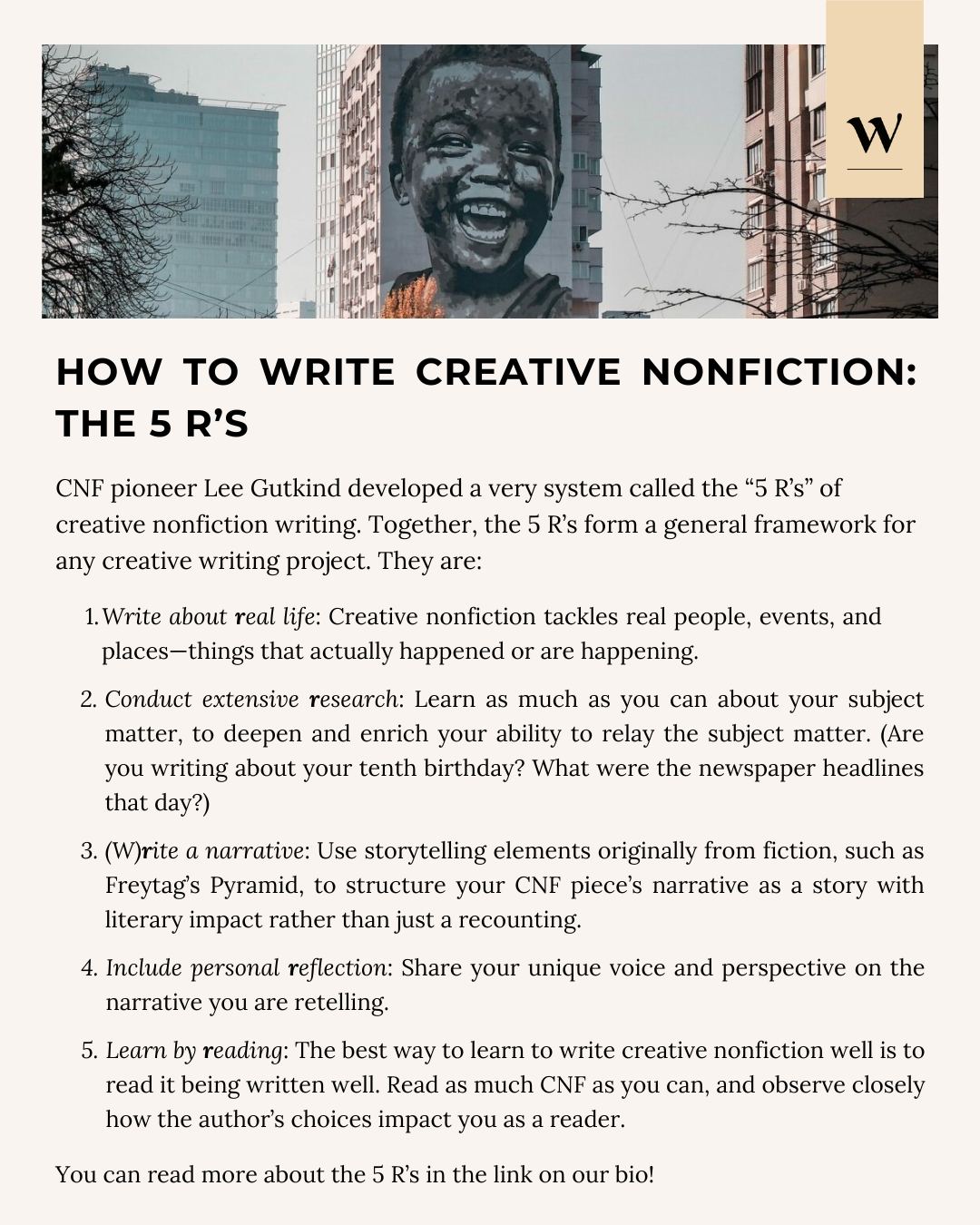
We’re sharing writing tips, creative prompts, and a steady stream of encouragement—follow us @writersdotcom. Click below to check out one of our latest posts on writing creative nonfiction.