Write into the Week: August 2, 2026
Elle LaMarca | August 2, 2026 |
“You must stay drunk on writing so reality cannot destroy you.” — Ray Bradbury
 Dear Writer,
I hope you’re having a good start to your week. In this newsletter:
- A writing prompt to inspire your creativity.
- Reading and listening recommendations in fiction, nonfiction, and poetry.
- Publishing, residency, and retreat opportunities available now.
- Join our free Monday and Friday write-ins, and meet our community of writers.
Happy writing this week!
—Elle, Curriculum Specialist & Instructor
Writer to Writer: Keeping the Thread Intact
Last month, I moved from Hawaii to Nebraska. That sentence is tidy enough, but the experience itself was anything but. I gave up my home in Hawaii, packed nearly all of my earthly belongings to be placed on a boat to sail across the Pacific, lived in a hotel for a week before departing, and then traveled to Omaha, a place I had never been, only to check into another hotel while the rest of my life slowly made its way toward me. That less tidy sentence is a better indicator of the experience.
In the middle of that kind of upheaval, it’s easy to ask: How am I supposed to keep producing work? How am I supposed to sit down and put words on the page when my ordinary life has been packed, shipped, interrupted, and rearranged? But I’m not sure that’s the most helpful question. For me, the better question is: How can I stay connected to my writing in a way that supports me rather than asks more of me than I can reasonably give?
The answer begins with reminding myself that writing is not only something I have to do. It is something I get to do. Something I want to do. Above all, writing is something that grounds me. It keeps me connected to myself, to my imagination, and to the creative dreams that still matter even when the non-creative parts of life become overwhelming, stressful, or uncertain.
That said, staying connected to writing during a period of transition also requires me to adjust my expectations. I cannot expect the same level of output from myself when I am living out of suitcases, sleeping in unfamiliar rooms, and waiting for the rest of my life to arrive. If I hold myself to the same standards I would during a calmer season of life, I’m only setting myself up to feel defeated by goals that were unrealistic in the first place. No one wins in that scenario—especially not me or my writing.
But adjusting my expectations does not have to mean disconnecting from the writing completely. Instead of declaring the whole month a creative loss, I’ve been trying to find smaller, gentler ways to remain close to my writing life. On the airplane, I read a fiction craft book I’d been meaning to read for the last year. After arriving in Omaha, I took myself on an artist date to a reading lounge that serves both books and cocktails. (How fun is that?!) Throughout the move, I kept a small notebook and pen in my bag so I could write down thoughts and observations about the closing of one chapter of my life and the beginning of another.
Sometimes, staying connected to your craft means producing new pages. Other times, it means reading something that reminds you why stories matter. It means noticing the details of an unfamiliar place, jotting down one sentence before bed, asking a question you don’t know how to answer yet, or letting a difficult season become material without demanding that it immediately become art. During times of turmoil, upheaval, and stress, our creative lives may need to become smaller for a while, but smaller does not mean empty or without merit. Sometimes the goal is simply to keep the thread intact until we have the space and strength to follow it again.
Writing Prompt: A Small Journey
This week, I challenge you to take a notebook somewhere new.
You don’t have to travel far, or across an ocean. Instead, maybe you go across town, around the corner, or simply across the street. The goal is to visit a place you don’t usually go, and to sit and pay attention. Immerse yourself in the moment, and become the ultimate observer.
Some ideas of places to go: a park bench, café, library, hotel lobby, museum, bus stop, bookstore, garden, train station, waiting room, or unfamiliar block in your own neighborhood. Once you arrive, write down what you notice. Let yourself collect details without worrying yet organizing your thoughts in any way. Record the sounds, colors, overheard fragments, textures, questions, or feelings that rise up while you’re there.
Then, (don’t skip this step!) let those notes rest for a few days. Do nothing with them immediately. Later in the week, return to them and notice what calls to you creatively. Follow that thread. Use whatever spark you find as the beginning of a new poem, scene, essay, or story. Let the journey be small. Sometimes a change in location is enough to change what we can see.
Reading Recommendations
Poetry:
- 3 Poems by Sean Glatch via The Rumpus. This week, I’m delighted to recommend three poems by Writers.com staff member, Sean Glatch, recently published in The Rumpus. I hope you’ll read them as both an encounter with one writer’s language and imagination, and as a reminder that creative work is always happening in the communities we help build.
Fiction:
- “Waiting for Alice” by Alex Erdekian via The Rumpus. In this short story, Erdekian uses expertly utilizes sentence structure to create the feeling of a mind in free fall. The prose is quick, funny, anxious, and cutting, building an atmosphere where social comedy and moral dread sit uncomfortably close together.
Nonfiction:
- “Big Beautiful Home” by Vonetta Young via The Rumpus. In this moody personal essay, Young writes about home as both a longed-for place of safety and a site haunted by instability, memory, and fear. The essay’s opening moves between nightmares, family history, and the promise of a new house, creating immediate tension between what it means to finally arrive somewhere and what it takes to feel secure once you do.
Listening Recommendations
- From The Creative Process podcast – “Humans are Storytelling Animals: Poets, Novelists & Musicians on the Power of Writing” – Why do we write? Is it to capture a memory before it vanishes or to build a bridge between the person we are and the stories we’ve been told? This episode explores the practice of writing as an awakening and tool for discovery with a group of celebrated poets, novelists, musicians and thinkers.
- From The Creative Penn Podcast for Writers – “Writing The Hard Stuff: Turning Difficult Subjects Into Meaningful Prose with Nicole Walker” – How do you write about the most painful experiences of your life without being overwhelmed by them? How can timed writing and a braided story help you untangle your hardest stories? Listen and learn more with writer Nicole Walker.
Creative Tool of the Week: Poemancer
This week, I’m thrilled to share a very cool and inspiring creative project from Writers.com lead administator, Sean Glatch. Sean has developed Poemancer, a card game for writing inspired poetry. The card decks can be combined in endless ways to help writers discover the poems waiting inside them, turn poetry into play, and have fun writing the poems they need to write.
Poemancer is currently fundraising through Kickstarter, and all backers will be the first to receive a copy of the game, likely by Spring 2027. If you’re a poet, a teacher of poetry, or simply someone who wants to bring more play and surprise into their writing practice, you can learn more about Poemancer on Kickstarter before it closes on August 15.
Publishing Opportunities:
- Passager Journal — Submission Window: July 15 – September 15, or until they reach their submission cap (400). Passager Journal publishes fiction, nonfiction, and poetry by authors who are 50 and older. In this instance, writers must be 50 or older by February 1st, 2027, to submit.
- Poetry International’s Summer Tiny Chapbook Competition – Submission Deadline: September 1, 2026. Submissions are now open for the 2026 Summer Tiny Chapbook competition. They are accepting chapbook submissions of 8-16 pages, any genre. There is a $20 reading fee.
- The Hope Prize Short Story Competition – Submission Window: June 1-October 1, 2026. The Hope Prize is a global short story competition open to writers from anywhere in the world. Stories can be on any genre or topic, but must be written in prose, and be a maximum of 5,000 words.
- Louise Glück Prize for Best Poem or Prose – Submission Window: Open. Poetries in English Magazine is currently accepting submissions for the inaugural Louise Glück Prize for Best Poem or Prose prize. The winner will receive publication in the magazine and a $1000 award. All submissions will be considered for publication.
Monday and Friday: Free Group Writing Sessions
Come write with us! Community write-ins are a great way to meet other writers, and carve out space in your calendar for your writing.
Monday: Write Into the Week with Elle
Join me (Elle) for an hour of mindset support, goal setting, community, and dedicated time to write! We’ll meet on Monday at 11 AM Eastern time, at this Zoom link: https://us02web.zoom.us/j/83999379617
Friday: Open Write-In
Join the Writers.com staff for a 90-minute writing session each Friday from 11 AM to 12:30 PM Eastern time. We will write together for the first hour. In the last, optional half hour, we’ll share our writing with one another and connect.
To add yourself, join our newsletter using the join box above, and add yourself to the “Friday Write-Ins” list at the bottom of any email. We’ll send you a Zoom link the morning of the call.
Join us on Instagram for more writing inspiration!
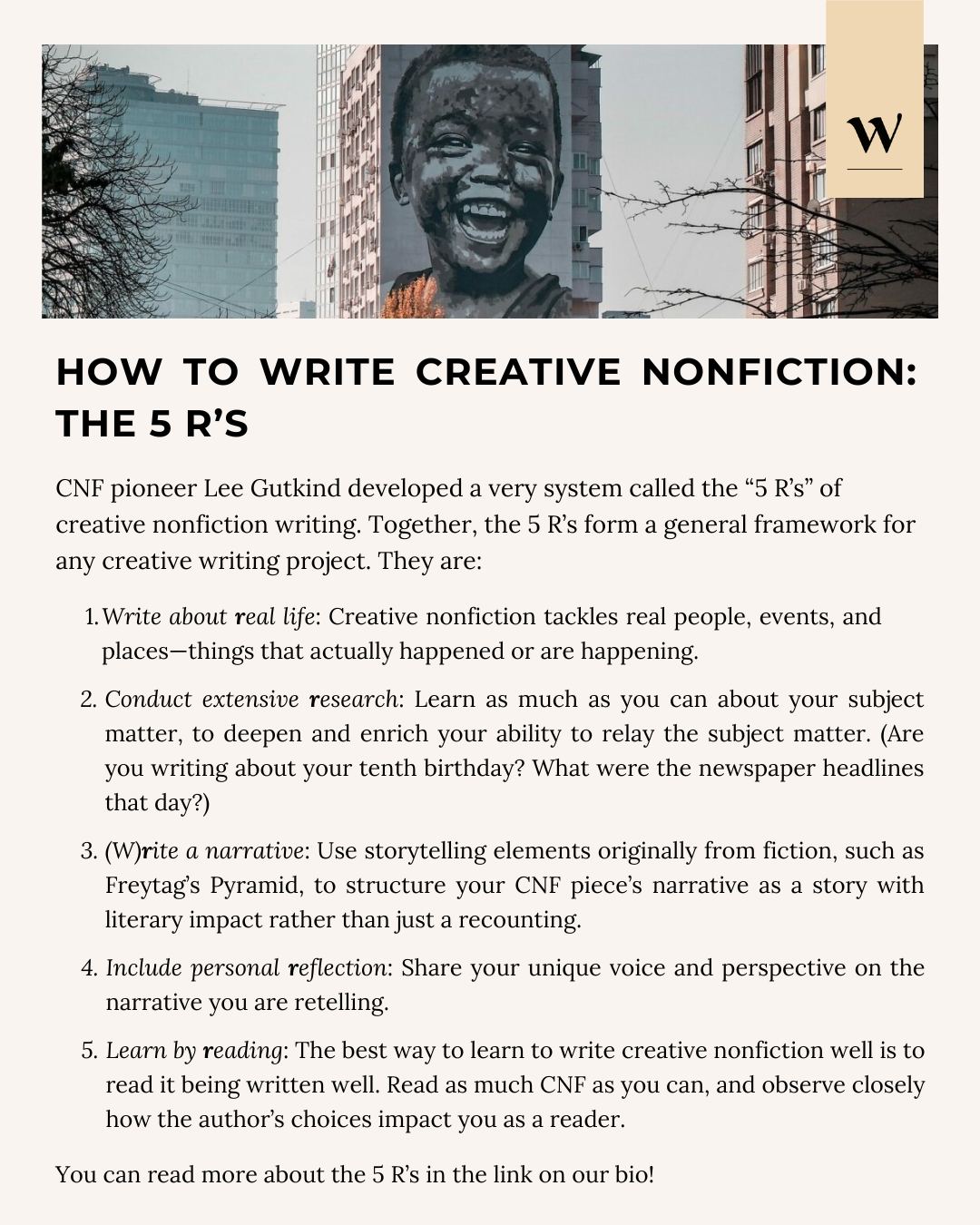
We’re sharing writing tips, creative prompts, and a steady stream of encouragement—follow us @writersdotcom. Click below to check out one of our latest posts on writing creative nonfiction.