Write into the Week: September 27, 2026
Elle LaMarca | September 27, 2026 |
“Life starts all over again when it gets crisp in the fall.” — F. Scott Fitzgerald
 Dear Writer,
I hope you’re having a good start to your week. In this newsletter:
- A writing prompt to inspire your creativity.
- Reading and listening recommendations in fiction, nonfiction, and poetry.
- Publishing, residency, and retreat opportunities available now.
- Join our free Monday and Friday write-ins, and meet our community of writers.
Happy writing this week!
—Elle, Curriculum Specialist & Instructor
Writer to Writer: The Confidence that Comes with Time
This week’s newsletter happens to land on my birthday (surprise!), which has me thinking about growing older (no surprise!). I know that isn’t always an uncomplicated subject, but I can honestly say that, so far, I’m enjoying my forties—a lot. Not every part, of course. I don’t love discovering my newly achy knees or realizing I can no longer read anything without reading glasses after having 20/20 vision my entire life. But I do love, love, love the particular kind of clarity that has accompanied this part of life.
The older I get, the less interested I am in shaping myself around other people’s opinions and expectations. I’m almost embarrassed to admit just how much my fear of being perceived controlled many of my decisions. Yet now, I feel more comfortable in my own skin than I did when I was younger, even if that skin has more lines and wrinkles. I’m less willing to shrink myself in advance of someone else’s judgment. I’ve spent a lot of my life worrying about being “too much”: too sensitive, too talkative, too emotional, too opinionated, too intense, etc. These days, I happily accept that I am indeed too much for some people, but that doesn’t make it a problem for me solve.
As our practice spans the years, I think something similar can happen in our writing lives.
When we are still finding our way on the page, it’s easy to become overly concerned with how our work will be received. Will people like this? Will they think it’s strange, or that I’m strange for writing it? Is this too emotional, dark, ambitious, or personal? We often make the mistake of trying to make the work more palatable, hoping to please every reader. We may sand down the very edges that give the piece its energy because we are afraid of being misunderstood or disliked.
But part of maturing as a writer is learning that our job is not to become universally pleasing. Trying to make our work likable to everyone often makes it more easily forgettable. Our job as writers is to be honest, attentive, and more fully ourselves on the page. That does not mean we stop caring about audience or feedback—it means we stop confusing external approval with artistic purpose. Praise can be lovely; publication can be meaningful; recognition can open doors, but none of those things can replace the deeper work of learning what we value, and what kind of writer we desire to be.
There is a freedom in realizing and accepting that not every reader will be your reader. Some people may not understand your voice, your style of humor, or your way of seeing the world. That’s okay! The goal is never to flatten the work until no one can object to it. My goal is the opposite: I want to make people feel, even if what they feel doesn’t always result in praise.
As I complete another lap around the sun, I find myself grateful for the ways age has made me less apologetic for simply being myself. I want that for my writing, too.
My creative goals for the future are to keep growing into a voice that does not ask permission to exist or to be liked. I want to trust the ideas, questions, and stories that pull at my attention, begging to be put down on paper. I want my writing to be and feel as confident as I do in my forties, and I hope the same for you. May your writing grow with you, and may it become less eager to please and more rooted in the truths you want to tell.
Writing Prompt: Best Birthday, Worst Birthday
Reflect on and write about your best birthday, and then do the same for your worst birthday. Fiction writers, you can do this for a character, and create a wonderful backstory. Poets, you could make this into one poem that compares and contrasts the two events, or two separate poems that mirror each other. Essayists, you could braid the two events into one narrative.
Revisit the circumstances of each birthday: where you were, who was there, what you expected, what actually happened, and how you felt at the time. Then look for the similarities and differences between the two experiences. What did each birthday reveal about your expectations, relationships, or the version of yourself you were then?
Literary Device of the Week: Idiolect
An idiolect is the unique way an individual person uses language. It may include a person’s favorite words and phrases, sentence patterns, pronunciation, slang, grammatical choices, and even the kinds of comparisons or expressions they naturally reach for. This is different from dialect, which is shared by a group, region, or community. An idiolect belongs specifically to one person.
For writers, idiolect can be a useful and powerful way to create distinctive and memorable characters. Two people in a story may come from the same geographic region, speak the same language, and even belong to the same family, yet still sound entirely different from one another. For example, one character may speak in long, winding sentences while another rarely uses more than a few words at a time. This will have an effect on readers, because your characters will feel more real and alive on the page.
A classic example in literature would be Elizabeth Bennet vs. Mr. Collins in Pride and Prejudice. Elizabeth’s dialogue is quick, witty, and often ironic. This is remarkably different than Mr. Collins, whose words tend to be more elaborate, overly formal and full of excessive flattery. Austen rarely needs to tell us who is speaking, because her characters’ individual relationships with language often do the work for her.
Idiolect is also a useful way to think about our own writing voice. Over time, each of us develop patterns in the language we choose, the rhythms we favor, and the way we arrange our thoughts on paper. Some of those habits may need revising, of course, but others are part of what makes our work recognizably ours.
I’m not encouraging you to make every sentence sound unusual for the sake of being different or memorable. That can turn readers off quickly. Instead, try to pay attention to the language that comes most naturally to a particular character—or to you—and resist smoothing away every quirk simply because it might not appeal to everyone or seems a bit unconventional. Let your voice be your voice.
Publishing Opportunities:
- Electric Literature – Submission Window: Septembeer 28-Ocotber 11, 2026. Electric Lit’s submission window for personal narrative essays opens this week! Submissions will remain open until October 11th or until they receive 500 submissions—which ever comes first. Don’t delay! (Note: Submissions won’t open until the 28th!)
- James Hearst Poetry Prize – Submission Deadline: November 1, 2026. The James Hearst Poetry Prize, presented by the North American Review, is a competition intended to recognize the finest poetry. They welcome all forms of previously unpublished poetry and up to five poems per submission. The winner receives $1,000 and publication.
- Kurt Vonnegut Speculative Fiction Prize – Submission Deadline: November 1, 2026. The Kurt Vonnegut Speculative Fiction Prize, presented by the North American Review, is an annual fiction competition intended to recognize the finest speculative fiction, which can include, but is not limited to, work influenced by the postmodern science-fiction of Kurt Vonnegut. The winner receives $1,000 and publication.
- Chrysalis Journal – Submission Deadline: November 30, 2026. Chrysalis is a bilingual literary and visual arts journal. They are currently open to submissions of art, poetry, fiction and nonfiction in both English and Spanish.
Residencies, Retreats & Fellowships
- Djerassi Resident Artists Program – Application Deadline: October 9, 2026. Applications for 2027 residencies are now open! The Djerassi Resident Artist Program has awarded over 2700 writers, visual/media artists, composers, choreographers, filmmakers and scientists for the past 42-years the gift of time and space with a one-month residency on their 583-acre ranch in Northern California’s Santa Cruz Mountains. All at no cost to the artists. (Elle has attended multiple residencies there, and she highly encourages you to apply!)
- The Fresh Voices Fellowship – Application Deadline: October 15, 2026. The Fresh Voices Fellowship, offered by Epiphany magazine, awards early career writers of color a $2,000 stipend, a one-year editorial fellowship, and publication in a print issue of Epiphany.
Monday and Friday: Free Group Writing Sessions
Come write with us! Community write-ins are a great way to meet other writers, and carve out space in your calendar for your writing.
Monday: Write Into the Week with Elle
Join me (Elle) for an hour of mindset support, goal setting, community, and dedicated time to write! We’ll meet on Monday at 11 AM Eastern time, at this Zoom link: https://us02web.zoom.us/j/83999379617
Friday: Open Write-In
Join the Writers.com staff for a 90-minute writing session each Friday from 11 AM to 12:30 PM Eastern time. We will write together for the first hour. In the last, optional half hour, we’ll share our writing with one another and connect.
To add yourself, join our newsletter using the join box above, and add yourself to the “Friday Write-Ins” list at the bottom of any email. We’ll send you a Zoom link the morning of the call.
Join us on Instagram for more writing inspiration!
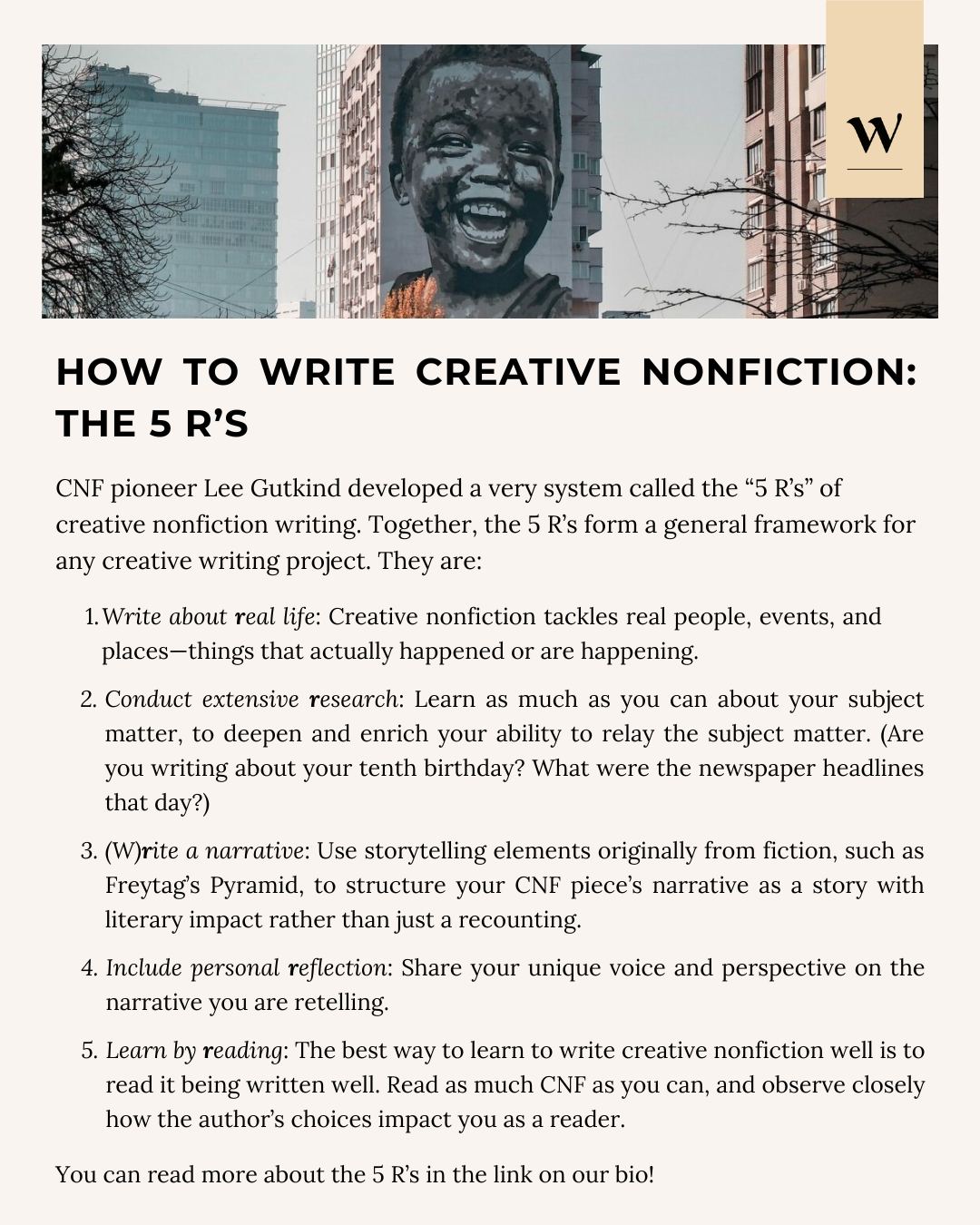
We’re sharing writing tips, creative prompts, and a steady stream of encouragement—follow us @writersdotcom. Click below to check out one of our latest posts on writing creative nonfiction.