Write into the Week: September 13, 2026
Elle LaMarca | September 13, 2026 |
“Autumn is a second spring when every leaf is a flower.” — Albert Camus
 Dear Writer,
I hope you’re having a good start to your week. In this newsletter:
- A writing prompt to inspire your creativity.
- Reading and listening recommendations in fiction, nonfiction, and poetry.
- Publishing, residency, and retreat opportunities available now.
- Join our free Monday and Friday write-ins, and meet our community of writers.
Happy writing this week!
—Elle, Curriculum Specialist & Instructor
Writer to Writer: Returning to Rhythm
Even though I am no longer a college student or public school teacher, September always makes me want to purchase a new notebook, buy pencils just to sharpen them, and become the kind of person whose planner is full and organized down to the minute. I just can’t seem to shake that old back-to-school feeling, even though school, in the traditional sense, isn’t a part of my Septembers anymore.
I don’t think I’m alone in this. Fall often arrives with a particular kind of energy for many of us. It’s usually a mixture of hope, renewed focus, and a little anxiety about another year heading toward a close. September can make us want to recommit to our writing lives, return to abandoned projects, set new goals, and find our way back into a rhythm.
After my summer of moving, traveling, living out of suitcases, and trying to work and write from places that never quite felt settled, I understand the desire for rhythm. I want it, too. I want a familiar desk, a daily routine, a solid plan, and a sense that my writing life has a place to land. But I’m also trying to remind myself that returning to rhythm does not mean building some idealized version of my creative life from scratch. It does not mean punishing myself for what did or did not happen during a busy, disrupted season.
A writing rhythm should support your life, not ignore the actual shape of it. Read that again, and give it a moment to really sink in.
Before deciding what your ideal writing routine should be for the remainder of the year, it may be useful to look honestly at the life around your writing. First, consider the non-negotiables in your week: work, school, family, caregiving, meals, errands, appointments, rest. Next, ask yourself what truly has to be done, and what might be done less often, less perfectly, or with a little more flexibility. I mean, does anyone really need to vacuum four times a week? Maybe. But maybe not. Sometimes making space for writing begins not with asking ourselves to become more disciplined, but with asking where our time and energy are already going.
From there, consider what kind of writing time is actually possible. Not the fantasy version that requires thirty hours in a day. Not the version that belongs to someone else, or even to your favorite writers. I’m talking about the version that could fit into your real life right now. This may mean one longer writing session each weekend, or twenty minutes before work twice a week. Maybe for you, it’s Friday afternoons devoted to revision, or keeping a notebook open while dinner is in the oven. You don’t have to write every day to be a writer, but if your schedule doesn’t allow for daily writing, it’s helpful to have a plan. Remember, the goal is not to create a perfect routine—it’s to create a rhythm you can return to.
Fall does not have to be a demand. Instead, let it be an invitation. You do not need to become an entirely new writer this season, or make up for every hour you didn’t write over the summer. You only need to listen for the rhythm that might carry you forward: steady enough to support you, flexible enough to let you keep living, and kind enough to welcome you back when you lose the beat.
Writing Prompt: Color, Transitions & Change
Use color to emphasize a moment of change in a piece of writing.
Choose a scene, memory, character, place, or emotional turning point, and pay attention to the colors that surround it. Maybe the light shifts from gold to gray, a room feels washed in blue, or the green of early spring suggests something beginning again.
Let your color choices do more than describe the surface of the scene. Use them to deepen the mood, sharpen the contrast between before and after, or suggest what is changing beneath the visible world. Consider: What color belongs to the moment before the change? What color arrives after? What happens in the transition between them?
Writerly Watch List
- “The Secret Behind Decades of Daily Writing w/ David Sedaris” via David Perell’s YouTube channel. David Sedaris has built a celebrated career out of noticing what is surprising, ridiculous, and strange about ordinary life—and then writing it all down. In this video, he shares how observation, daily journaling, and a willingness to enter absurd situations have shaped his humor, essays, and decades-long writing life, making it especially worthwhile for writers interested in sharpening their attention and finding material in unexpected places.
- “Learn the Magic Formula for Memoir and Narrative Nonfiction” via Brad Wetzler’s Writing the Heart YouTube Channel. In this video, journalist, memoirist, and Writers.com instructor Brad Wetzler introduces his VAST Method for shaping narrative nonfiction and memoir. Writers working with personal material may find this especially useful for thinking about how to organize lived experience into a compelling story with movement, meaning, and emotional depth.
Listening Recommendations
- From Marlon & Jake Read Dead People podcast – “The Literary Hall of Shame” – In this episode, Marlon and Jake look at what happens when great writers miss the mark, exploring the weaker books by authors they otherwise admire. Writers may especially enjoy the conversation for its craft-minded attention to what can go wrong on the page: fiction that leans too heavily on ideas, novels that chase the present too closely, prose that needs a stronger editor, and the tricky difference between brilliance and a fully realized book.
- From the Between the Covers: Conversations with Writers podcast – “Milkweed Live: Creature Needs with Thalia Field, David Naimon & Anne de Marcken” – In this conversation, Thalia Field, David Naimon, and Anne de Marcken discuss *Creature Needs*, an anthology that invited writers to respond creatively to scientific studies on animal conservation. The episode offers a fascinating look at art as a form of inquiry, exploring how poems, essays, and hybrid work can engage with science, challenge its assumptions, and make room for the more-than-human world on the page.
Publishing Opportunities:
- The Kenyon Review – Submission Deadline: September 30, 2026. Currently open for general submissions in short fiction, flash fiction and essays, poetry, and excerpts from larger works, and translation.
- New Plains Review Contest – Submission Deadline: October 13, 2026. $1,000 prize for poetry and fiction. They are specifically interested in work focused on water. Please see the guidelines on their Submittable page for more details.
- Chrysalis Journal – Submission Deadline: November 30, 2026. Chrysalis is a bilingual literary and visual arts journal. They are currently open to submissions of art, poetry, fiction and nonfiction in both English and Spanish.
Residencies, Retreats & Fellowships
- Vermont Studio Center Residency – Application Deadline: September 30, 2026. Residency applications are now open for the Vermont Studio Center. Artists and writers in all forms and genres are welcome to apply for residencies happening from July to December 2027. All residents receive partial fellowship, and 35% receive fully funded fellowships.
- Lighthouse Works Fellowship – Application Deadline: October 1, 2026. Lighthouse Works offers six-week, year-round fellowships for cultural producers, with housing, food, private studio space, and $1,750 in financial support. Fellows stay in a shared Victorian house, gather for staff-cooked dinners most nights, and work in private, light-filled studios facing the ocean near Silver Eel Cove, with access to a wood and metal fabrication shop and kiln. The residency is designed to give fellows time and space to focus on their work, while an Artist Talk and Open Studio create opportunities for conversation, critique, and connection.
- Djerassi Resident Artists Program – Application Deadline: October 9, 2026. Applications for 2027 residencies are now open! The Djerassi Resident Artist Program has awarded over 2700 writers, visual/media artists, composers, choreographers, filmmakers and scientists for the past 42-years the gift of time and space with a one-month residency on their 583-acre ranch in Northern California’s Santa Cruz Mountains. All at no cost to the artists. (Elle has attended multiple residencies there, and she highly encourages you to apply!)
Monday and Friday: Free Group Writing Sessions
Come write with us! Community write-ins are a great way to meet other writers, and carve out space in your calendar for your writing.
Monday: Write Into the Week with Elle
Join me (Elle) for an hour of mindset support, goal setting, community, and dedicated time to write! We’ll meet on Monday at 11 AM Eastern time, at this Zoom link: https://us02web.zoom.us/j/83999379617
Friday: Open Write-In
Join the Writers.com staff for a 90-minute writing session each Friday from 11 AM to 12:30 PM Eastern time. We will write together for the first hour. In the last, optional half hour, we’ll share our writing with one another and connect.
To add yourself, join our newsletter using the join box above, and add yourself to the “Friday Write-Ins” list at the bottom of any email. We’ll send you a Zoom link the morning of the call.
Join us on Instagram for more writing inspiration!
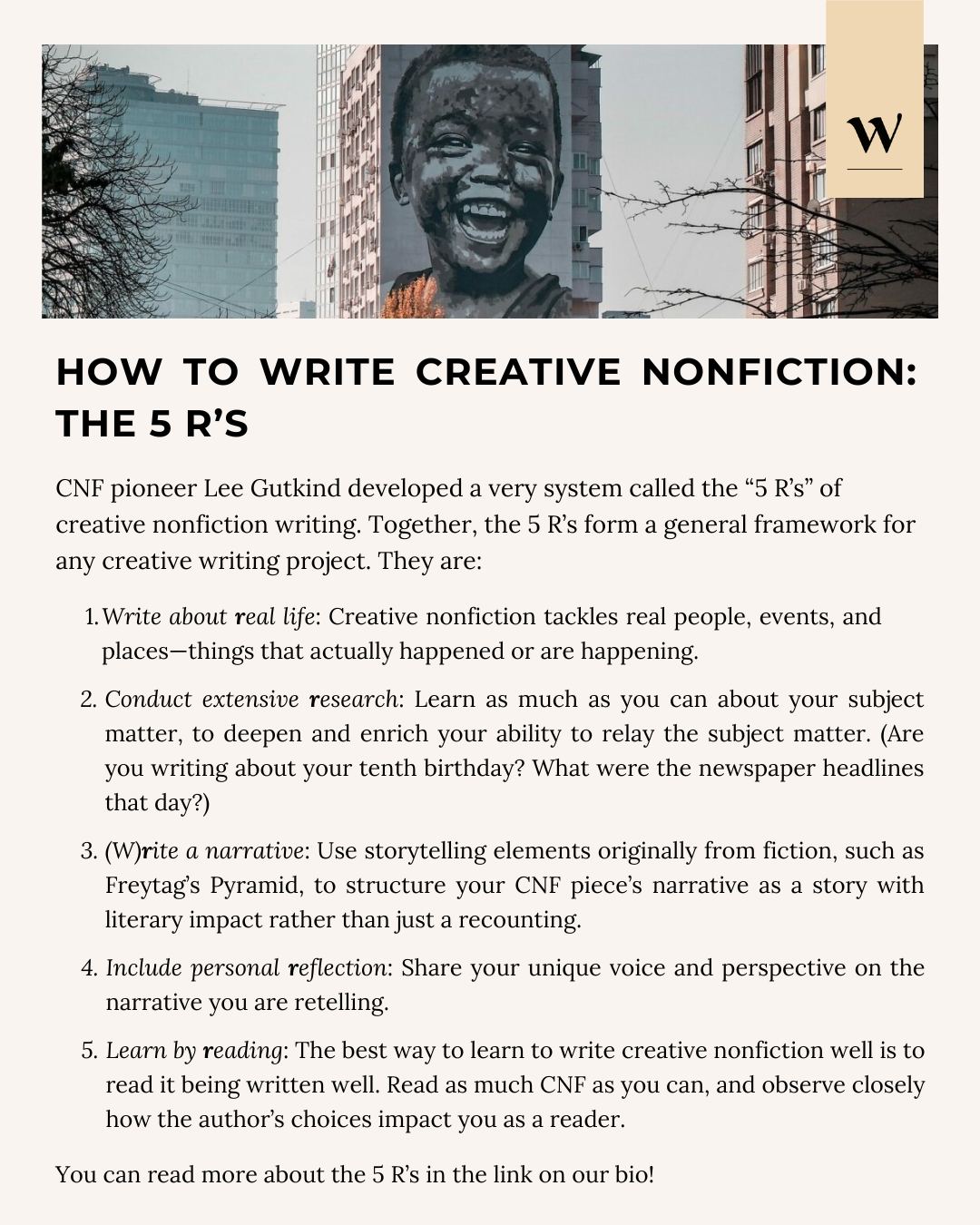
We’re sharing writing tips, creative prompts, and a steady stream of encouragement—follow us @writersdotcom. Click below to check out one of our latest posts on writing creative nonfiction.