Write into the Week: May 31, 2026
Elle LaMarca | May 31, 2026 |
“One day I will find the right words, and they will be simple.”
–Jack Kerouac
 Dear Writer,
I hope you’re having a good start to your week. In this newsletter:
- A writing prompt to inspire your creativity.
- Reading and listening recommendations in fiction, nonfiction, and poetry.
- Publishing, residency, and retreat opportunities available now.
- Join our free Monday and Friday write-ins, and meet our community of writers.
Happy writing this week!
—Elle, Curriculum Specialist & Community Manager
Writer to Writer: Build the House First
In my work with writers and as a developmental fiction editor, one of the most frequent misconceptions about writing I come across is that good writing has to be complicated and/or wildly unique.
I think this misunderstanding begins innocently enough. Perhaps we read a beautiful sentence by a favorite author and become intoxicated by the elegance of the language, or we admire a novel with a complex story structure or an essay filled with bold and original phrasing. As a result, somewhere along the way, we start focusing on how the writer said something rather than what they were trying to say.
The result is that many writers begin decorating the walls before they’ve built the house.
Don’t worry, I’m not judging. I’m certainly guilty of this myself. Instead of focusing on the concept or emotion I’m trying to capture, I’ve found myself searching for the “perfect” sentence before I’ve fully understood what I wanted the sentence to accomplish. But the truth is that both my most meaningful work and some of the most powerful writing I’ve ever read are remarkably simple on the surface. The language isn’t drawing attention to itself, nor is the writer trying to prove how clever they are. Instead, they’re focused on communicating something as clearly, honestly, and effectively as possible. That should be our first goal as writers.
This doesn’t mean simple writing is easy writing. And I’m in no way suggesting you avoid using literary devices, writing beautifully complex sentences, or attempting ambitious forms. Those things absolutely have their place within our writing, but they work best when they’re in service of the content rather than competing with it.
When I’m stuck, I often find it helpful to return to a basic question: What am I actually trying to say in this piece?
When I catch myself fussing over a sentence, trying to make it more impressive, more surprising, or more “writerly,” I usually take that as a sign that I’ve lost sight of the piece itself. That’s when I return to the purpose and intention of the work, and figure out what I’m actually trying to say. Once I know the answer, the writing usually comes much easier, the right details emerge, and the proper form reveals itself eventually without me trying to force it.
If you ever find yourself overcomplicating a piece, try stripping it back to its essential truth by focusing on the thing you’re trying to communicate rather than the performance of communicating it. I promise, there’s always time to make a piece more complex later. Clarity and authenticity, however, are much harder to edit in after the fact.
Writing Prompt: The Simplest Way
Think of something you’ve been trying to understand, explain, or write about lately. It could be a memory, relationship, emotion, or a question that keeps coming up in your mind or on the page.
Try writing about it using the simplest language and form available to you. Resist the urge to sound poetic, profound, or especially writerly. I encourage you instead to focus on being clear, and to tell the truth as directly and openly as you can.
If you find yourself reaching for a flourish of decorative language, ask yourself: What am I actually trying to say? Follow that answer.
Reading Recommendations
- Poetry:
- The Book of Alice by Diamond Forde. A bold and inventive poetry collection that blends family history, biblical language, Southern traditions, and myth. Forde explores inheritance, identity, and womanhood with a voice that feels both ancient and surprisingly contemporary.
- Fiction:
- Angel Down by Daniel Kraus. Recent winner of the 2026 Pulitzer Prize for fiction, Angel Down is a remarkable example of what can happen when a writer takes a formal risk and fully commits to it. The novel is told in a single, uninterrupted sentence as a symbol of the constant stress of war. Kraus blends literary fiction, magical realism, and speculative elements as the narrative follows World War I soldiers who discover a fallen angel.
- Nonfiction:
- Magical Realism: Essay on Music, Memory, Fantasy, and Borders by Vanessa Angelica Villarreal. Part memoir and part cultural criticism, this genre-bending collection examines what is lost, inherited, and reimagined through migration, family history, and popular culture. Villarreal’s essays are intellectually ambitious while remaining deeply personal and emotionally resonant.
Literary Device of the Week: Compression
Compression is the art of saying more with less. Writers use compression when they condense emotion, information, or meaning into a surprisingly small amount of space. When done well, the result is a single image, line of dialogue, or carefully chosen detail that reveals more than an entire paragraph of explanation.
Think of the difference between telling a reader that a marriage is struggling versus showing one spouse eating dinner alone at the kitchen counter while the other works late again. The second example doesn’t explain much, but it invites the reader to do some of the emotional work themselves.
Compression is one of the reasons “simple” writing can feel so powerful. The language may appear straightforward on the surface, yet underneath it carries layers of meaning, implication, and emotion. Rather than spelling everything out, the writer trusts the reader to connect the dots. (Please trust your readers!) When used well, compression creates writing that feels both economical and expansive.
Remember, a few carefully chosen words can echo far beyond the space they occupy on the page.
Publishing Opportunities:
- Prairie Schooner Summer Creative Nonfiction Contest – Submission Window: May 15-August 1, 2026. This contest is open to all types of creative nonfiction essays, up to 5,000 words. This year’s contest will be judged by Orenda Fink, author of The Witch’s Daughter. The entry fee is $20. Winner receives $1,000 and publication in the following Spring issue.
- Electric Literature’s Emerging Writers Contenst 2026 – Submissions Open: July 1st. This is Electric Lit’s inaugural emerging writers contest for both poets and fiction writers. One winner in each genre will receive $1,000, publication in either Recommended Reading (fiction) or The Commuter (poetry), and two weeks at the Writing Downtown residency program in Downtown Las Vegas, started by Plympton and the Writer’s Block bookstore. Second-place winners will receive $250, and third-place winners will receive $100. All fiction finalists will receive a review with feedback from a literary agent. This is a great opportunity! Start prepping your submissions now! Note: Submissions do not open until July 1, 2026. For more details, check out Electric Lit’s Instagram page.
- CRAFT Literary – Submission Window: Open. Seeking submissions of fiction, creative nonfiction and craft essays. CRAFT explores the art of prose, celebrating both emerging and established writers. They focus on the craft of writing and how the elements of craft make a story or essay shine.
Monday and Friday: Free Group Writing Sessions
Come write with us! Community write-ins are a great way to meet other writers, and carve out space in your calendar for your writing.
Monday: Write Into the Week with Elle
Join me (Elle) for an hour of mindset support, goal setting, community, and dedicated time to write! We’ll meet on Monday at 11 AM Eastern time, at this Zoom link: https://us02web.zoom.us/j/83999379617
Friday: Open Write-In
Join the Writers.com staff for a 90-minute writing session each Friday from 11 AM to 12:30 PM Eastern time. We will write together for the first hour. In the last, optional half hour, we’ll share our writing with one another and connect.
To add yourself, join our newsletter using the join box above, and add yourself to the “Friday Write-Ins” list at the bottom of any email. We’ll send you a Zoom link the morning of the call.
Join us on Instagram for more writing inspiration!
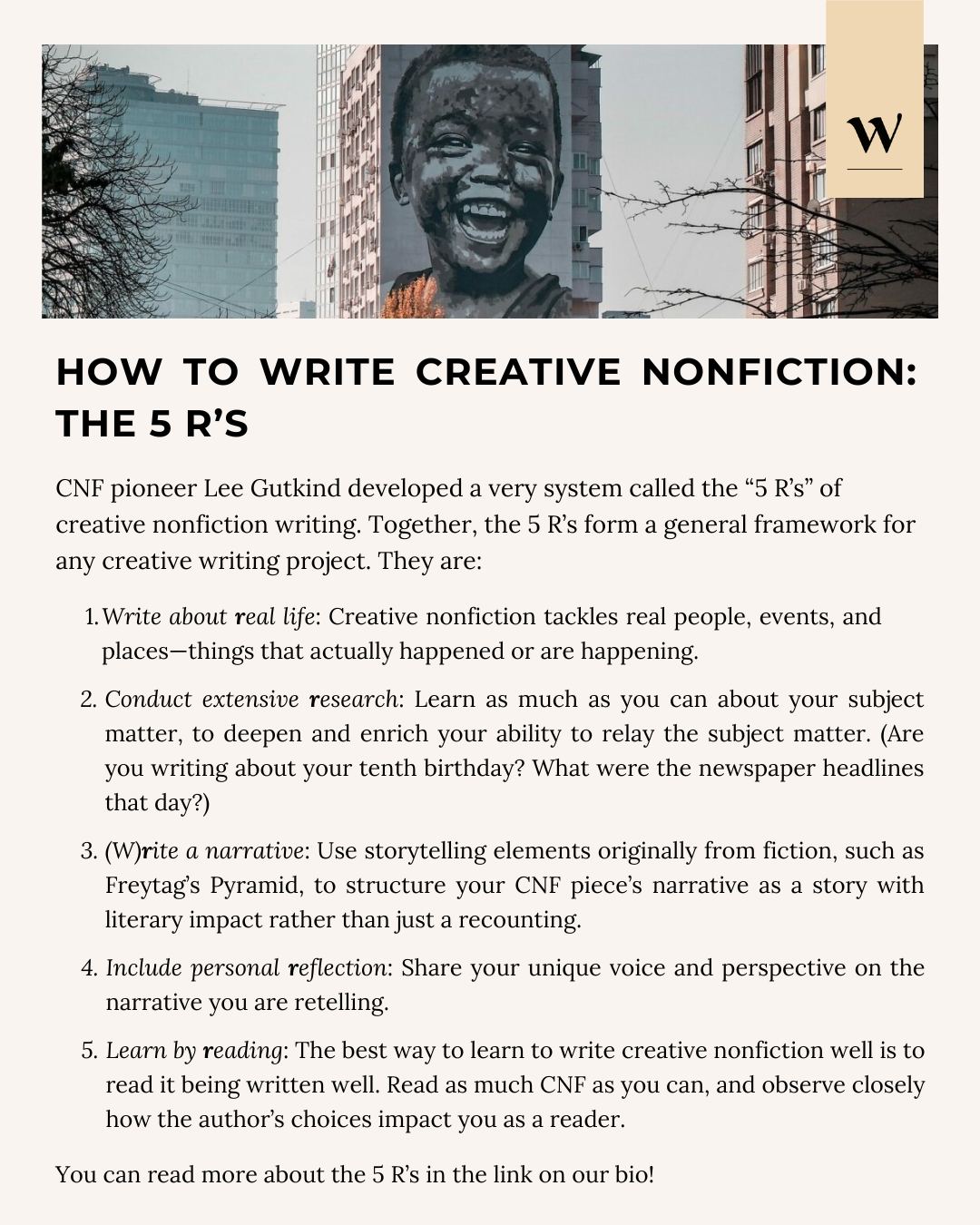
We’re sharing writing tips, creative prompts, and a steady stream of encouragement—follow us @writersdotcom. Click below to check out one of our latest posts on writing creative nonfiction.