Write into the Week: May 10, 2026
Elle LaMarca | May 11, 2026 |
“I write to discover what I know.”
–Flannery O’Connor
 Dear Writer,
I hope you’re having a good start to your week. In this newsletter:
- A writing prompt to inspire your creativity.
- Reading and listening recommendations in fiction, nonfiction, and poetry.
- Publishing, residency, and retreat opportunities available now.
- Join our free Monday and Friday write-ins, and meet our community of writers.
Happy writing this week!
—Elle, Curriculum Specialist & Community Manager
Writer to Writer: Writing to Know
Once you’ve been a writer long enough, you’re bound to hear the phrase write what you know. And while that can be useful advice in certain contexts—especially when it comes to emotional truths or lived experience—it can also become limiting advice if taken too literally. It can make writing feel narrow, as though we’re only allowed to work from what’s familiar, proven, or already understood.
But I think many of us write for the opposite reason. We write to discover. That’s what I love about this week’s quote by Flannery O’Connor, “I write to discover what I know.”
Sometimes the writing itself becomes the process of understanding. We begin with an image, a voice, a scene, or a feeling we can’t quite explain or one we’re trying to work through, and through writing we begin to uncover what’s underneath it. In these instances, the writing leads to knowing, not the other way around.
I think most writers have certain emotional territories they return to over and over again, sometimes without fully realizing it. We circle the same kinds of relationships, desires, and fears across multiple pieces of work. Certain images or dynamics keep resurfacing. We become fascinated by particular questions long before we understand why they matter so much to us.
For me, I’ve long returned to stories about friendship, loneliness, and the complicated ways people try—and fail—to fully know one another. I didn’t consciously choose those themes. They just happened to be where my writing often lead me. It happened enough that I finally began to understand what they were trying to teach me about myself.
That’s one of the strange and beautiful gifts of writing—sometimes the page knows exactly what we need, even before we do.
We often begin a story believing we’re writing about one thing, only to realize partway through (or at the end!) that something deeper has revealed itself. What first looked like a vacation scene becomes a study in performance, with everyone working far too hard to seem happy. Or, maybe, character keeps scrubbing the counters, and slowly, cleanliness starts to look more like a need for control. Even a small object added on instinct—an illegible receipt, an old wool sweater, a diamond ring—can suddenly reveal what the story has been circling all along. Writing can become a form of excavation. Not just expression, but discovery.
This week, you might consider the themes, images, or emotional questions that continue appearing in your own work. What subjects do you keep circling back toward? What kinds of characters or tensions feel magnetic to you? What are you still trying to understand?
You may already be writing toward truths you don’t full know yet.
Writing Prompt: What Isn’t Known
This week, instead of writing what you know, I challenge you to write about what you don’t know. Here are three options to try:
- Open your piece with the phrase, “I don’t know…” Use it once as an opening, or allow it to repeat throughout the piece as refrain.
- Write about what you don’t know, but wish you did.
- What about something you’ve recently learned that was previously unknown to you.
Reading Recommendations: Writing Craft Edition
- The Plot Whisperer: Secrets of Story Structure Any Writer Can Master by Martha Alderson. An incredibly useful craft book for writers who struggle with plot, pacing, or structure. What I appreciate most is that Alderson treats plot not as a rigid formula, but as something deeply connected to character transformation and emotional movement, making structure feel far more organic and alive.
- Old Friend from Far Away: The Practice of Writing Memoir by Natalie Goldberg. This is one of the most generous and inspiring books on memoir writing I’ve ever read. Rather than focusing on polished narratives and publishing advice, Goldberg treats memoir as a process of attention and discovery, using meditative prompts and associative exercises to help you uncover the deeper emotional truths hidden inside memory.
- How to Write It: Work with Words by Anthongy Anaxagorou. This craft text great for poets lends writing advice, personal narrative, and publishing insight in a way that feels both practical and encouraging. What I especially appreciate is how much permission the book gives writers, not just to improve their work, but to think differently about language, creativity, and who gets to call themselves a writer.
Listening Recommendations
- From Fresh Air podcast – “Best of Novelist Douglas Stuart/’Half Man’ Actor Richard Gadd” – Like the main character in his Booker Prize-winning novel Shuggie Bain, writer Douglas Stuart grew up in Glasgow, working class, queer, and with a mother addicted to alcohol. His first career was in fashion, designing underwear for Calvin Klein. He spoke with host Terry Gross about his new novel, John of John.
- From The Poetry Cafe podcast – “Suave the Poet: From Basic Training to Passion and Poetry” – This episode features the story of a poet trying to find his way, the journey, the connections, and the promise for a new day.
Publishing Opportunities:
- 2026 PI Prize – Submission Deadline: May 31, 2026. The Poetry International Prize sponsored by Poetry International awards a cash prize of $1000 and publication for a single poem of any length. Submit up to 3 poems with a $15 entry fee. You may submit additional poems for a $3 reading fee per poem. All entries are considered for publication.
- The Baltimore Review’s Summer Contest– Submission Deadline: May 31, 2026. Open call for submissions of prose poem, flash fiction and flash creative nonfiction for The Baltimore Review’s Summer Contest. All entries will be considered for publication in their regular issues, and winners will each receive $400. There is an $8 entry fee.
- Prairie Schooner Summer Creative Nonfiction Contest – Submission Window: May 15-August 1, 2026. This contest is open to all types of creative nonfiction essays, up to 5,000 words. This year’s contest will be judged by Orenda Fink, author of The Witch’s Daughter. The entry fee is $20. Winner receives $1,000 and publication in the following Spring issue.
- House House Magazine – Submission Deadline: Open. House House Magazine, a student run magazine out of Harvard University, is currently open for submission of poetry, fiction and essays. Criteria is 1-2 new poems, 1000-6000 word original fiction, and 3000-7000 word personal essays.
Residency, Retreat, & Fellowship Opportunities:
- 2026 Whiting Nonfiction Grant for Works-in-Progress – Application Deadline: May 31, 2026. The 2026 Whiting Nonfiction Grant for works in progress of $40,000 will be awarded to ten writers completing a deeply researched and imaginatively composed book-length work of nonfiction. The grant supports multiyear projects at crucial mid-process stage. Please review the application details to determine if your work aligns.
- PEN America Literary Grants – Application Deadline: June 15, 2026. Applications are currently open for PEN America’s annual liteary grants. The PEN America Literary Awards, Grants, and Fellowships Program has honored many of the most outstanding voices in literature across diverse genres, including fiction, poetry, nonfiction, children’s literature, translation, and drama. Please review the application details to see if your work aligns.
Monday and Friday: Free Group Writing Sessions
Come write with us! Community write-ins are a great way to meet other writers, and carve out space in your calendar for your writing.
Monday: Write Into the Week with Elle
Join me (Elle) for an hour of mindset support, goal setting, community, and dedicated time to write! We’ll meet on Monday at 11 AM Eastern time, at this Zoom link: https://us02web.zoom.us/j/83999379617
Friday: Open Write-In
Join the Writers.com staff for a 90-minute writing session each Friday from 11 AM to 12:30 PM Eastern time. We will write together for the first hour. In the last, optional half hour, we’ll share our writing with one another and connect.
To add yourself, join our newsletter using the join box above, and add yourself to the “Friday Write-Ins” list at the bottom of any email. We’ll send you a Zoom link the morning of the call.
Join us on Instagram for more writing inspiration!
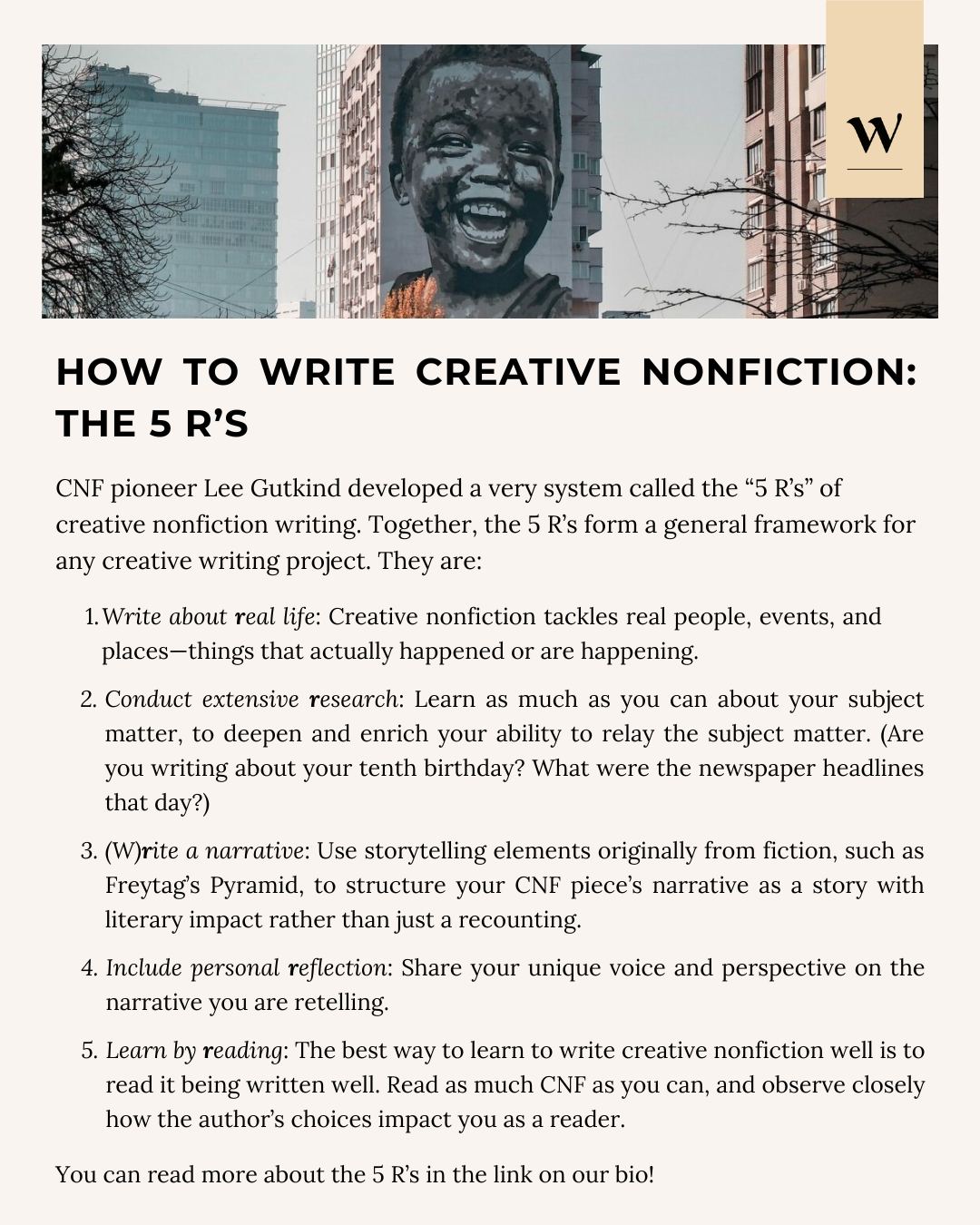
We’re sharing writing tips, creative prompts, and a steady stream of encouragement—follow us @writersdotcom. Click below to check out one of our latest posts on writing creative nonfiction.