Write into the Week: June 12, 2026
Elle LaMarca | July 13, 2026 |
“Write what should not be forgotten.” — Isabel Allende
 Dear Writer,
I hope you’re having a good start to your week. In this newsletter:
- A writing prompt to inspire your creativity.
- Reading and listening recommendations in fiction, nonfiction, and poetry.
- Publishing, residency, and retreat opportunities available now.
- Join our free Monday and Friday write-ins, and meet our community of writers.
Happy writing this week!
—Elle, Curriculum Specialist & Instructor
Writer to Writer: To My Monday Morning Writers
Last week, I wrote about the importance of finding your writing people. This week, it feels only right to continue that thought by saying thank you to one of the communities that has most shaped my own writing life—the writers who show up each Monday for the Write into the Week live session.
There is no Monday session this week, as I’m in the process of moving, so this feels like a fitting moment to pause and reflect on how this group started and what it has become. When Write into the Week began a year and a half ago, we were a small gathering of writers, often seven to ten people on a Monday morning, showing up with coffee, notebooks, and whatever creative energy we could bring to the start of the week. Some of those OG writers are still there almost every Monday! Over time, the group has grown into a much larger community, with 45 to 50 writers joining from different countries, time zones, writing genres, and from stages of writing experience.
What has moved me most is not only that the group has grown, but that so many writers return. Again and again. People come once, and then they come back. They make space for their writing in the midst of busy lives. They cheer each other on in the chat, and really get to know each other. They share their goals, celebrate every kind of creative win, offer encouragement, and remind one another that the work of writing truly matters. We have fiction writers, poets, memoirists, essayists, novelists, screenwriters, beginners, and writers who have been at this for years. Somehow, across all those differences, we find common connections each week.
It means a great deal to know that I have helped create a space where writers can show up for themselves and their creativity, and feel safe in doing so. I know some people may come for the prompts, structure, or the gentle accountability of beginning the week writing, but I also know this: the community exists because of the writers who keep showing up each week with generosity. It thrives because of the kindness people offer one another. It grows because writers make it safe for other writers to take risks, experiment, and share even the earliest of rough drafts.
This has become one of the highlights of my week, even when I have to wake up at 4 a.m. in Hawaii to lead a 5 a.m. session. There are Monday mornings when I am still half-asleep as I make my coffee, but by the time writers begin sharing their wins for the week, something in me wakes up too. The Zoom room becomes its own kind of energy. It reminds me why I love teaching, why I believe deeply in creative practice, and why writing alongside other people (even strangers!) can be so powerful, influential and inspirational.
Every so often, someone sends me an email after a session to say thank you, or to share a piece they wrote, or to tell me that one of my prompts helped them write something they are proud enough to share. Those messages mean more to me than I can properly say. They remind me that a writing community does not have to be formal or overly literary to be meaningful. Community can be built in small, consistent ways—one Monday at a time, one shared goal at a time, one person deciding to come back to writing because other people are doing the same.
So this week, while I am away from our usual Monday meeting and surrounded by moving boxes instead of pens and notebooks, I want to say, THANK YOU. Thank you to the writers who have been coming since the beginning, to the writers who joined somewhere along the way, and to the writers who are still new to the group. Thank you for your presence, trust, kindness, creativity, and your willingness to support writers working in forms and genres different from your own.
You have helped make Write into the Week what it is. Not just an hour long writing session, and not just a place to get a few words down before the week begins, but a growing, thriving creative community. I feel lucky to be part of it. Once more, thank you.
Writing Prompt: Take Your Pick!
In light of my absence from the live session this week, I offer, not one, but four prompts for your consideration, and that hopefully spark some inspiration.
- Write about a room or shared space, real or imagined, that seems to hold the energy of everyone who has entered it. What happens once they leave?
- Draft a piece about someone returning to a place, practice, person, or ritual after time away. What is easy about return? What is hard? Why did they leave? Why did they return?
- Write a poem or letter of gratitude to anyone or anything your (or a character) are grateful for.
- Write about strangers brought together by a shared need, event, task, or mystery.
Literary Device of the Week: Personification
Personification is a literary device in which human qualities and attributes are given to something nonhuman: an object, animal, place, idea, force of nature, or emotion.
For instance, a house might remember, a storm may threaten, or a sentence could resist a writer trying to finish it. Personification allows the nonhuman parts of a piece to do more than sit quietly in the background or be a part of the setting, literally. Instead, personification can make a setting, object, or idea feel active within the emotional life of a piece of writing.
For writers, personification can be especially useful when you want a setting or object to carry more meaning. Obviously, a room does not literally know what has happened inside it, but in a piece of creative writing, that room can seem to hold secrets, absorb grief, offer comfort, or refuse to allow the past disappear. In this way, personification allows the external world to reflect a character’s inner life without requiring the writer to explain everything directly. Sometimes, the world around a character can say what the character cannot yet say for themselves.
As you experiment with personification, pay attention to what quality you’re giving the nonhuman thing. Think about new plays on common clichés. The ocean might be restless, but how else could you describe it? The goal is not simply to make an object seem human, but to reveal something about the emotional atmosphere of the piece in a unique and original way that resonates with readers.
Listening Recommendations
- From The Dialogue Doctor podcast – “The Secret to Using Dialogue to Build Character Chemistry” – In this episode, Jeff Elkins works with author Gladys Strickland on how to make a first meeting between two important characters feel alive with tension, chemistry, suspicion, and possibility. Their conversation explores practical craft choices around POV, setting, body language, dialogue, and how to weave research or worldbuilding into a scene without overwhelming the reader.
- From The Daily Stoic Podcast – “Men Are Reading Less Fiction. That’s A Problem w/ Steven Pressfield” – In this episode, host Ryan Holiday talks with Steven Pressfield about why fiction still matters, especially at a time when men are reportedly reading less of it. Their conversation considers how novels can teach courage, honor, sacrifice, and the human experience in ways that advice-driven nonfiction often cannot.
Publishing Opportunities:
- Silly Goose Press – Special Issue Submission Window: July 1-15, 2026. Silly Goose has opened their submissions for two weeks only for a super fun special issue. Per their website: The Sturgeon Moon is set to rise on Thursday, August 27, and we want to leave her an offering. We’re looking for your midnight moonlit mythologies, your odes to the Great Lakes goddesses, your meditations and manifestations, your rites and rituals, and your love letters to the never-topped muse, The Moon. Open to all genres (there’s no one way to worship a Sturgeon Moon after all) and for two weeks only.
- Tupelo Press – Submission Window: July 1-August 31, 2026. Tupelo Press is open for submissions during their summer open reading period. This is not a competition. They will select and publish writing they love. They are open to submissions of full-length and chapbook-length poetry submissions, and they select multiple titles for publication.
- The Drue Heinz Literature Prize – Submissions Open July 1, 2026. The Drue Heinz Literature Prize, awarded by the University of Pittsburg Press, recognizes and supports writers of literary short fiction and makes their work available to readers around the world. The Prize is open to authors who have published at least three short stories or novellas, or one book-length collection of fiction, or a novel. Please see the website for more details, guidelines, and submission requests.
- Poetry International’s Summer Tiny Chapbook Competition – Submission Deadline: September 1, 2026. Submissions are now open for the 2026 Summer Tiny Chapbook competition. They are accepting chapbook submissions of 8-16 pages, any genre. There is a $20 reading fee.
- The Hope Prize Short Story Competition – Submission Window: June 1-October 1, 2026. The Hope Prize is a global short story competition open to writers from anywhere in the world. Stories can be on any genre or topic, but must be written in prose, and be a maximum of 5,000 words.
Monday and Friday: Free Group Writing Sessions
Come write with us! Community write-ins are a great way to meet other writers, and carve out space in your calendar for your writing.
Monday: Write Into the Week with Elle
Join me (Elle) for an hour of mindset support, goal setting, community, and dedicated time to write! We’ll meet on Monday at 11 AM Eastern time, at this Zoom link: https://us02web.zoom.us/j/83999379617
Friday: Open Write-In
Join the Writers.com staff for a 90-minute writing session each Friday from 11 AM to 12:30 PM Eastern time. We will write together for the first hour. In the last, optional half hour, we’ll share our writing with one another and connect.
To add yourself, join our newsletter using the join box above, and add yourself to the “Friday Write-Ins” list at the bottom of any email. We’ll send you a Zoom link the morning of the call.
Join us on Instagram for more writing inspiration!
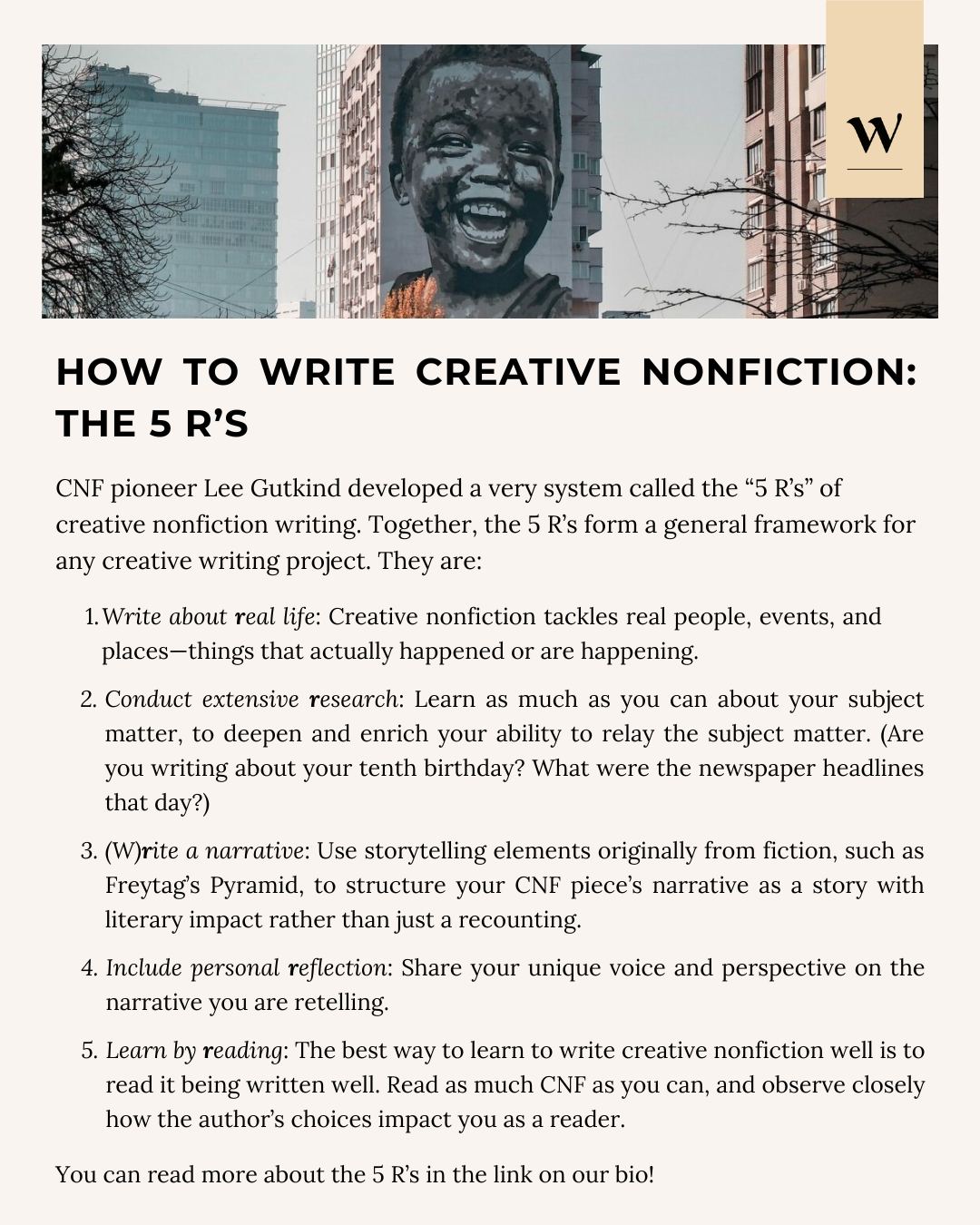
We’re sharing writing tips, creative prompts, and a steady stream of encouragement—follow us @writersdotcom. Click below to check out one of our latest posts on writing creative nonfiction.