Write into the Week: April 26, 2026
Elle LaMarca | April 26, 2026 |
“The true alchemists do not change lead into gold; they change the world into words.”
–William H. Gass
 Dear Writer,
I hope you’re having a good start to your week. In this newsletter:
- A writing prompt to inspire your creativity.
- Reading and listening recommendations in fiction, nonfiction, and poetry.
- Publishing, residency, and retreat opportunities available now.
- Join our free Monday and Friday write-ins, and meet our community of writers.
Happy writing this week!
—Elle, Curriculum Specialist & Community Manager
Writer to Writer: The Alchemy
While looking for a quote for this week’s newsletter, I am across one I hadn’t read before by William H. Gass, “The true alchemists do not change lead into gold; they change the world into words.” After reading, I was instantly warmed by that sunny internal feeling I get whenever a read a good, good sentence.
Indeed, there is something a little magical about writing, isn’t there? I’ve always thought so. We sit alone with a blank page and somehow make something from nothing—a character who did not exist begins to breathe, memory becomes a scene, or an emotion hard to name transforms into meaning on the page.
We writers are strange like that. We spend so much of our lives paying attention to the world. We’re always observing happenings what around—collecting gestures, stealing bits of overheard dialogue, considering the smell of rain on ashpahlt, or imagining the exact shade of loneliness. Then, somehow, we take all of these seemingly arbitrary observations, and transform them. We don’t copying life exactly, but we do translate it. We turn experience into language, and observation into meaning.
That feels like a most special kind of alchemy. Magic that doesn’t require a wand.
Maybe that’s why writing can feel both exhilarating and impossible. We are trying to make something invisible visible. We are trying to take all of the messy, murky and unnameable parts of life, and give them form on the page.
When it works—when a reader feels seen inside something we wrote from our own imagination—it can feel like the closest thing to magic there is. When I look at it that way, I think about what a privilege it is to be a writer. It’s a strange and beautiful responsibility to turn the world into words, and words into worlds.
I hope you have a magical wordy week.
Writing Prompt: Transformation
Write a piece in which something ordinary transforms into something unexpected.
It could be literal. Consider things like a houseplant that begins speaking a family’s secrets, a snowstorm that alters someone’s memory, or a room that remembers every argument it’s witnessed. Or it could be more emotional. Consider something like grief that shifts to tenderness, anger that results clarity, or loneliness that is actually freedom.
Think about what writers do every day: we take fragments of real life and turn them into art. This week, let yourself lean fully into that magic. Remind yourself that transformations of all kinds are possible.
Wordy Facts: Spell
Keeping with this week’s magical theme, I ask that you consider the word spell. I love that spell carries two meanings at once. It can mean arranging letters into words, but it can also mean enchantment, magic, or the act of casting something into the world and hoping it transforms.
That overlap is perfectly right for writers. We really are magicians! We sit down and quite literally spell—placing one word after another, trying to create meaning, emotion, and change. We take thoughts that only exist inside us, and give them life on paper.
Writing has always been a kind of spellwork. No, it isn’t truly mystical, but, more so, because language has the power to alter perception and understanding. A sentence can make someone remember, grieve, laugh, forgive, or feel seen. If that’s not a little bit like magic, what is?
Literary Device of the Week: Symbolism
Symbolism is surely a form of magic on the page. Symbolism is when an object, image, place, or action carries meaning beyond its literal purpose. Consider your encounters in literature when a storm is rarely only about the weather, or a locked door represented fear or the possibility of everything a character isn’t yet ready to face. Think the green light at the end of the dock in The Great Gatsby, the conch shell in The Lord of the Flies, or the act of sewing in The Color Purple.
What makes symbolism so powerful is that it allows writers to communicate emotion and meaning without having to explain everything directly. It’s a great way to show without doing much telling. Instead of telling readers exactly how a character feels, you can let the world around them reflect it. Symbolism allows you to use specific artifacts and details, like a dying plant on a windowsill or a chipped coffee mug used every morning, that carry emotional weight for readers.
The best symbols usually start as something ordinary. Writers give them power through repetition, context, and attention. The object itself doesn’t need to be dramatic, special or fantastical; it simply needs to matter within the context of your narrative.
In this way, symbolism is a kind of transformation. The ordinary object stays itself, but through story, attention, and emphasis, it becomes charged with something more.
Publishing Opportunities:
- The Baltimore Review’s Summer Contest– Submission Deadline: May 31, 2026 Open call for submissions of prose poem, flash fiction and flash creative nonfiction for The Baltimore Review’s Summer Contest. All entries will be considered for publication in their regular issues, and winners will each receive $400. There is an $8 entry fee.
- The Poetry Lighthouse – Submission Deadline: May 15, 2026. Open call for submissions of original poetry, flash fiction, essays, and poetry manuscripts. Please review the submission guidelines via the website for more details.
- Literally Lit Magazine – Submission Deadline: May 15, 2026. Seeking submissions of high-quality fiction, poetry, creative nonfiction, and essays that will leave a lasting impression on their intelligent readers. Often looking for work that touches upon the topics of femininity, womanhood, identity, empowerment, and/or pop culture.
Residency, Retreat, & Fellowship Opportunities:
- PEN America Literary Grants – Application Deadline: June 15, 2026. Applications are currently open for PEN America’s annual liteary grants. The PEN America Literary Awards, Grants, and Fellowships Program has honored many of the most outstanding voices in literature across diverse genres, including fiction, poetry, nonfiction, children’s literature, translation, and drama. Please review the application details to see if your work aligns.
- 2026 Whiting Nonfiction Grant for Works-in-Progress – Application Deadline: May 31, 2026. The 2026 Whiting Nonfiction Grant for works in progress of $40,000 will be awarded to ten writers completing a deeply researched and imaginatively composed book-length work of nonfiction. The grant supports multiyear projects at crucial mid-process stage. Please review the application details to determine if your work aligns.
Monday and Friday: Free Group Writing Sessions
Come write with us! Community write-ins are a great way to meet other writers, and carve out space in your calendar for your writing.
Monday: Write Into the Week with Elle
Join me (Elle) for an hour of mindset support, goal setting, community, and dedicated time to write! We’ll meet on Monday at 11 AM Eastern time, at this Zoom link: https://us02web.zoom.us/j/83999379617
Friday: Open Write-In
Join the Writers.com staff for a 90-minute writing session each Friday from 11 AM to 12:30 PM Eastern time. We will write together for the first hour. In the last, optional half hour, we’ll share our writing with one another and connect.
To add yourself, join our newsletter using the join box above, and add yourself to the “Friday Write-Ins” list at the bottom of any email. We’ll send you a Zoom link the morning of the call.
Join us on Instagram for more writing inspiration!
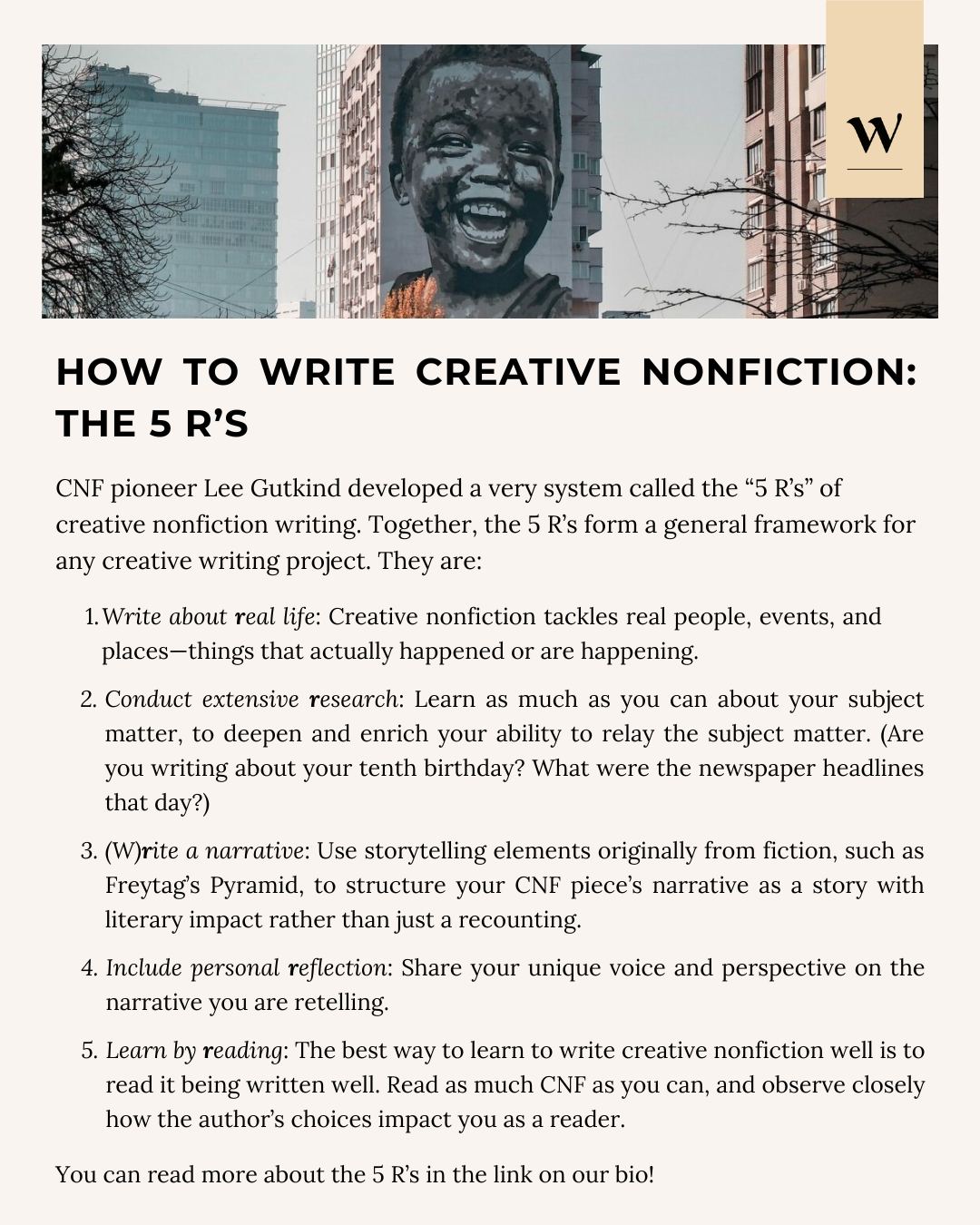
We’re sharing writing tips, creative prompts, and a steady stream of encouragement—follow us @writersdotcom. Click below to check out one of our latest posts on writing creative nonfiction.