Write into the Week: June 21, 2026
Elle LaMarca | June 19, 2026 |
“To produce a mighty book, you must choose a mighty theme.”
–Herman Melville
 Dear Writer,
I hope you’re having a good start to your week. In this newsletter:
- A writing prompt to inspire your creativity.
- Reading and listening recommendations in fiction, nonfiction, and poetry.
- Publishing, residency, and retreat opportunities available now.
- Join our free Monday and Friday write-ins, and meet our community of writers.
Happy writing this week!
—Elle, Curriculum Specialist & Community Manager
Writer to Writer: Writing that Reveals Us
One of the things I find fascinating about writers is that, given enough time, we eventually reveal ourselves.
I don’t mean because we all plan to write an autobiography one day. In fact, many of us may spend years avoiding direct autobiography in our writing. As a fiction writer, I’ve rarely been interested in recreating the actual events of my life on the page. (It’s a writer hang-up of mine; I’m working on it!) Yet when I look back across my stories and novels, I can see pieces of myself everywhere. Everywhere. The circumstances change, the characters are diverse, and the plots are entirely invented, but many of the same emotional concerns continue to surface in one form or another.
At first I worried that I lacked imagination, but eventually started thinking of it as a clue. Most writers have certain subjects, questions, images, symbols, or emotional territories that they return to again and again. Sometimes we know exactly why they matter to us. Other times, they appear first as patterns. A poet may find the same bird, body of water, or childhood room appearing across several poems before understanding what it represents. A memoirist may write about different eras of life while circling the same question of belonging. A novelist may invent an entirely new cast of characters, only to discover they are still writing about loyalty, abandonment, ambition, grief, or friendship.
As different as my stories are from one another, they almost always explore themes of friendship, complex family dynamics and self-abandonment. Even when I try not to write about these concepts, I still somehow end up writing about these concepts. These returns can be strange, especially when we notice them after the fact. Why does one image keep asking to be written? Why does a particular type of relationship continue to pull our attention? Why do we keep placing our characters in situations that echo something we thought we had left behind?
When I was younger, I thought of writing primarily as an escape. I loved that fiction allowed me to make something up, to leave my own life behind and enter a world I had created. I still love that about it. But the longer I write, the more I understand that even invention has a way of bringing us back to ourselves. Creative writing gives us room to explore what interests and confuses us, what delights or frightens us, and what refuses to leave us alone.
This is true across genres. Fiction writers may hide inside invented characters. Poets may return to the same images until those images begin to gather private meaning. Essayists and memoirists may approach lived experience directly, but even then, the story is shaped by what the writer chooses to notice, question, or withhold. Whatever the form, writing often becomes a record of our deepest fascinations.
I think this is one of the reasons our recurring themes deserve attention rather than embarrassment. They are not proof that we are repeating ourselves in some lazy or unimaginative way. Instead, they show us what we are still trying to understand.
Writing Prompt: What Returns
Look back at a few pieces you’ve written, or simply think about the kinds of stories, poems, essays, characters, images, or questions you often return to. Make a short list of two to four recurring elements in your work. These might be themes, symbols, settings, types of relationships, emotional conflicts, character types, objects, or even particular moods that seem to follow you from piece to piece.
Then choose one and write toward it deliberately.
The goal is not to prove you can write about something else, but to fully embrace what already seems to be calling for your attention. If you often write about loneliness, write directly into loneliness. If birds, houses, mothers, ghosts, childhood rooms, or lost friendships keep appearing in your work, let one of them take center stage.
Follow it with curiosity rather than judgment. What does this recurring element seem to know about you, your imagination, or the questions you’re still trying to understand?
Literary Device of the Week: Motif
Since this week’s newsletter discusses the themes, symbols, and questions we return to in our own writing, motif felt like a fitting literary device to explore.
The Poetry Foundation defines a motif as “a central or recurring image or action in a literary work that is shared by other works,” and notes that motifs are sometimes described as “expressions of a collective unconsciousness.” I love that idea, because it suggests that motifs aren’t only decorative patterns. They may also connect our individual stories to larger human questions, fears, desires, and myths.
In practice, a motif is a recurring image, object, phrase, idea, or situation that appears throughout a piece of writing, and gathers meaning each time it returns. A locked door, a particular song, color, family story, even a particular kind of weather, or a repeated line of dialogue can all become motifs–if they appear with enough intention.
What makes motifs powerful is that they can create emotional depth without requiring direct explanation. The first time an image appears, it may seem like an ordinary detail. The second or third time, the reader begins to understand that it matters. By the end of a story, essay, or poem, that repeated element may hold longing, fear, transformation, or grief.
Motifs are especially useful when you want to create cohesion across a longer piece or deepen a theme without stating it outright. They help the writing echo itself. Motifs allow meaning to build quietly, in the background.
If you notice something appearing again and again in your own writing, don’t be too quick to edit it out. Repetition can sometimes be accidental, but it can also be a clue. Pay attention to what keeps coming back. There may be a motif waiting to be developed.
Wordy Facts: Fascination
Once again, keeping with this week’s theme, I thought the word fascination was a perfect fit!
For me, a self-proclaimed word nerd, many words have a denotation, a conotation, and a vibe. Fascination has a vibe, because it feels both intellectual and a bit enchanted. To be fascinated by something is not simply to find it interesting; it suggests a stronger pull, the kind of attention that keeps drawing you back even when you aren’t entirely sure why.
The word comes from the Latin fascinare, meaning “to bewitch,” or “enchant,” and is connected to fascinum or fascinus, meaning “a charm, enchantment, spell, or witchcraft.” Is it just me, or does that origin feels especially fitting for writers? Our fascinations often do feel a bit like magic spells: the images, questions, places, and emotional territories we keep returning to as if something in them is asking to be understood.
Maybe that’s one way to think about the recurring material in your own work. Not as repetition or limitation, but as fascination. Something has caught your attention for a reason! Your job is to keep exploring long enough to find out why.
Publishing Opportunities:
- Hanging Loose Press – Submission Deadline: June 30, 2026. Calling all poets! This award-winning independent press turns 60 years old this year! Celebrate by submitting up to six original poems to be considered for publication.
- The Constance Rooke Creative Nonfiction Prize from The Malahat Review – Submission Deadline: August 1, 2026. Submit your best piece of creative nonfiction for a chance to win $1,250 and publication in The Malahat Review. All forms of CNF will be considered: personal essay, memoir, nature or travel writing, social commentary, historical account, biography, etc. The competition is judged by writer and journalist, Odette Auger.
- Poetry International’s Summer Tiny Chapbook Competition – Submission Deadline: September 1, 2026. Submissions are now open for the 2026 Summer Tiny Chapbook competition. They are accepting chapbook submissions of 8-16 pages, any genre. There is a $20 reading fee.
- The Hope Prize Short Story Competition – Submission Window: June 1-October 1, 2026. The Hope Prize is a global short story competition open to writers from anywhere in the world. Stories can be on any genre or topic, but must be written in prose, and be a maximum of 5,000 words.
Monday and Friday: Free Group Writing Sessions
Come write with us! Community write-ins are a great way to meet other writers, and carve out space in your calendar for your writing.
Monday: Write Into the Week with Elle
Join me (Elle) for an hour of mindset support, goal setting, community, and dedicated time to write! We’ll meet on Monday at 11 AM Eastern time, at this Zoom link: https://us02web.zoom.us/j/83999379617
Friday: Open Write-In
Join the Writers.com staff for a 90-minute writing session each Friday from 11 AM to 12:30 PM Eastern time. We will write together for the first hour. In the last, optional half hour, we’ll share our writing with one another and connect.
To add yourself, join our newsletter using the join box above, and add yourself to the “Friday Write-Ins” list at the bottom of any email. We’ll send you a Zoom link the morning of the call.
Join us on Instagram for more writing inspiration!
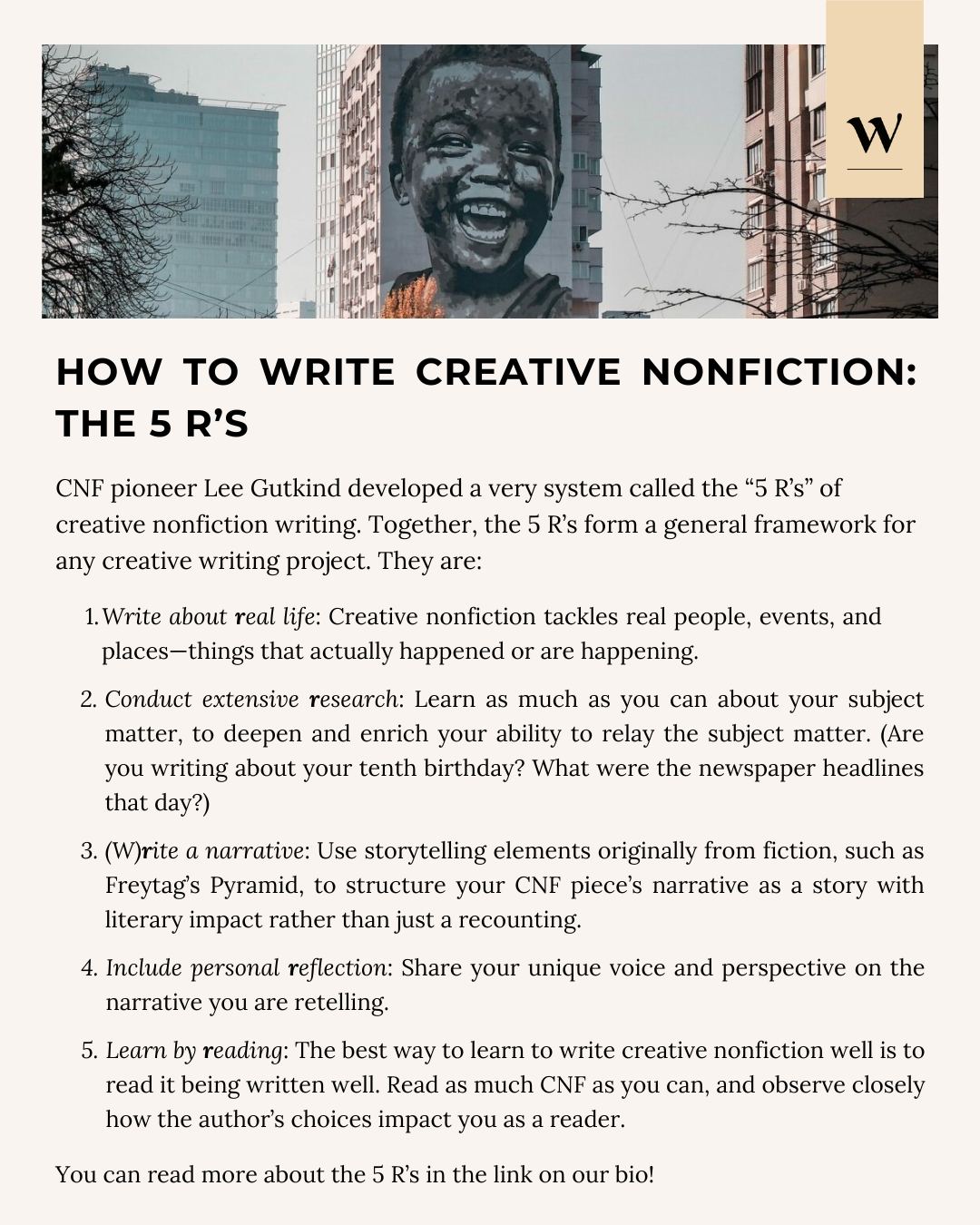
We’re sharing writing tips, creative prompts, and a steady stream of encouragement—follow us @writersdotcom. Click below to check out one of our latest posts on writing creative nonfiction.