Write into the Week: May 17, 2026
Elle LaMarca | May 17, 2026 |
“I am so clever that sometimes I don’t understand a single word of what I am saying.”
–Oscar Wilde
 Dear Writer,
I hope you’re having a good start to your week. In this newsletter:
- A writing prompt to inspire your creativity.
- Reading and listening recommendations in fiction, nonfiction, and poetry.
- Publishing, residency, and retreat opportunities available now.
- Join our free Monday and Friday write-ins, and meet our community of writers.
Happy writing this week!
—Elle, Curriculum Specialist & Community Manager
Writer to Writer: Where Your Voice Begins
“Find your voice” is one of the most common pieces of writing advice out there, and also, in my opinion, one of the least helpful.
Because what does that even mean?
It makes voice sound like something hidden under a rock somewhere, waiting to be discovered. As though one day you’ll wake up, write a sentence, and suddenly think, Ah yes, there it is. My voice. Found at last! But I don’t think voice works that way at all.
I think voice develops slowly, with consistency over years of writing. It emerges through repetition, creative risk, preference, confidence, obsession, influence, failure, and experimentation. It’s shaped by what you pay attention to, the details you focus on, and how you choose to write about them. But, also, by the kinds of sentences you naturally gravitate toward constructing, the words and phrases you choose, and how you organize and deliver your writing on the page. The more time you spend writing, the stronger your voice usually becomes.
Perhaps most importantly, voice strengthens when you stop trying to sound like the kind of writer you think people want to read, or the kind of writer you think you are supposed to be. I see so many writers flatten their own voices in an attempt to be more likeable—more literary, commercial, intellectual, or universal. Writers will smooth out their strangeness, remove the humor, specificity, emotional sharp edges, and the odd bits and fixations that actually make the writing feel alive. But voice often lives precisely in those places, and when you bland your writing down to make it more palatable for everyone, voice is often lost and the writing is often boring and unremarkable.
Voice lives in the rhythm of your sentences. It’s there in the subjects you return to over and over again, and inside your unique emotional perspective. Voice is not just how you write. It’s how your particular mind moves through the world, and how you translate that onto the page.
This means developing your voice requires a certain amount of trust. Not just in your writing, but in your own perception. That can be difficult, especially when writing workshops, social media, critiques, and comparison make it feel like every piece of writing must appeal to everyone. But the truth is, the writers with the strongest voices are rarely trying to please every reader. They’re writing from a place that feels deeply and unmistakably their own.
Ironically, that’s often what makes the work resonate most. And, as I told a group of writing students this week, the goal of creative writing should never be to please everyone. (It’s also impossible to do, so why bother trying?)
So, instead of asking yourself whether your writing sounds “good” or “correct” or like a writer you admire, you might ask a different question: Does this sound like me? Does it sound like a version of me that’s responding with authenticity, telling the most honest truth, and trusting myself creatively? Let that be where your voice begins.
Writing Prompt: That’s My Opinion!
Write passionately about something small and seemingly unimportant: your favorite kind of sandwich bread, airport carpets, expensive pens, the smell of sunscreen, hotel breakfast buffets, gas station coffee, reality TV reunions, etc. Don’t filter yourself; don’t worry about who might disagree with your opinion; just open the floodgates of your opinion and put it all on the page!
Voice often appears most clearly when we stop trying to sound writerly, and simply allow ourselves to sound like ourselves—opinionated, observant, specific and unique.
Wordy Fact of the Week: Personality
The word personality comes from the Latin persona, meaning “mask” or “character played by an actor.” It originally referred to the masks worn by actors in ancient Greek and Roman theater to project different character traits.
I love the contradiction hidden inside that origin. Something we now think of as our truest, most authentic self began as a theatrical mask worn in performance. Writers wrestle with this tension all the time. Voice is deeply personal, but it’s also constructed. We choose what to reveal, what to exaggerate, and what to conceal. Our writing is both confession and performance.
A Closer Look: Great First Lines
“The first time I cheated, I was in the third grade.” — Luster by Raven Leilani
I love how much voice is packed into this single, opening sentence. It’s direct, confessional, a bit provocative, and immediately grabs the readers attention. It raises questions: Cheated how? On whom or what? And perhaps most importantly, what kind of narrator would choose to introduce themself this way?
That last question is part of what makes this opening so effective. Strong voice isn’t just about beautiful sentences or unusual word choices. More often, it comes from a narrator’s particular angle of attention: the details they choose to share first, the ones they withhold, and the emotional tone they establish before the story has barely begun.
In just eleven words, Leilani creates curiosity, personality, and tension. The sentence feels conversational, but carefully controlled and constructed. It sounds like someone speaking candidly, perhaps too candidly, which makes the reader lean closer almost immediately. That’s voice!
Publishing Opportunities:
- Blackbird Journal – Submission Window: Open. Currently open for submissions of poetry, fiction, creative nonfiction and craft essays. Please review their submission guidelines for more specifics. This journal is completely online. They do pay accepted writers!
- The University Press of Kentucky – Submission Window: May 1 – May 31, 2026. Currently seeking full-length poetry and fiction manuscripts for their award-winning series. Check their website for more details. Note: They may close submissions early if they receive 300 submissions before May 31st. Don’t wait!
- Prairie Schooner Summer Creative Nonfiction Contest – Submission Window: May 15-August 1, 2026. This contest is open to all types of creative nonfiction essays, up to 5,000 words. This year’s contest will be judged by Orenda Fink, author of The Witch’s Daughter. The entry fee is $20. Winner receives $1,000 and publication in the following Spring issue.
- House House Magazine – Submission Window: Open. House House Magazine, a student run magazine out of Harvard University, is currently open for submission of poetry, fiction and essays. Criteria is 1-2 new poems, 1000-6000 word original fiction, and 3000-7000 word personal essays.
Residency, Retreat, & Fellowship Opportunities:
- 2026 Whiting Nonfiction Grant for Works-in-Progress – Application Deadline: May 31, 2026. The 2026 Whiting Nonfiction Grant for works in progress of $40,000 will be awarded to ten writers completing a deeply researched and imaginatively composed book-length work of nonfiction. The grant supports multiyear projects at crucial mid-process stage. Please review the application details to determine if your work aligns.
- PEN America Literary Grants – Application Deadline: June 15, 2026. Applications are currently open for PEN America’s annual liteary grants. The PEN America Literary Awards, Grants, and Fellowships Program has honored many of the most outstanding voices in literature across diverse genres, including fiction, poetry, nonfiction, children’s literature, translation, and drama. Please review the application details to see if your work aligns.
Monday and Friday: Free Group Writing Sessions
Come write with us! Community write-ins are a great way to meet other writers, and carve out space in your calendar for your writing.
Monday: Write Into the Week with Elle
Join me (Elle) for an hour of mindset support, goal setting, community, and dedicated time to write! We’ll meet on Monday at 11 AM Eastern time, at this Zoom link: https://us02web.zoom.us/j/83999379617
Friday: Open Write-In
Join the Writers.com staff for a 90-minute writing session each Friday from 11 AM to 12:30 PM Eastern time. We will write together for the first hour. In the last, optional half hour, we’ll share our writing with one another and connect.
To add yourself, join our newsletter using the join box above, and add yourself to the “Friday Write-Ins” list at the bottom of any email. We’ll send you a Zoom link the morning of the call.
Join us on Instagram for more writing inspiration!
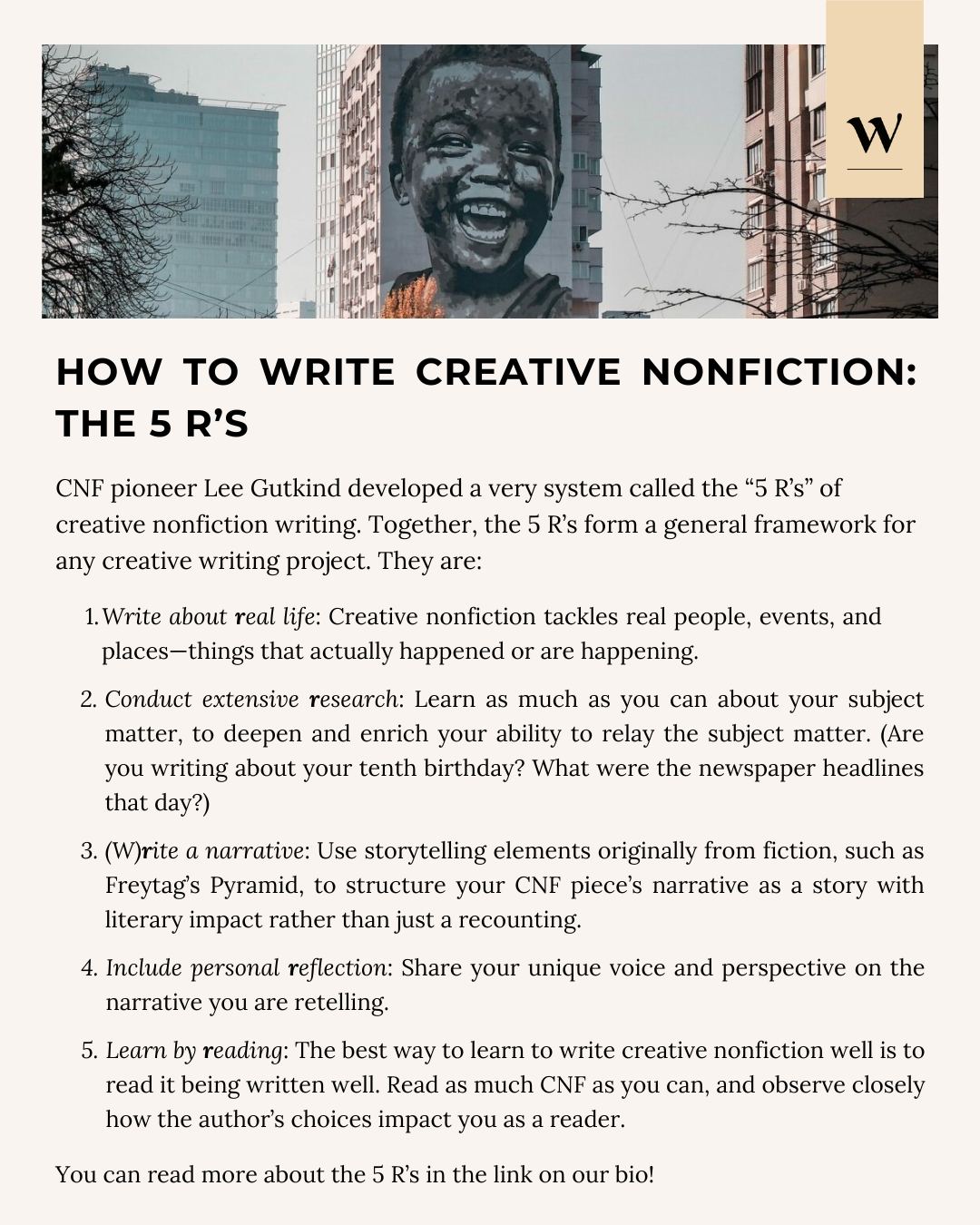
We’re sharing writing tips, creative prompts, and a steady stream of encouragement—follow us @writersdotcom. Click below to check out one of our latest posts on writing creative nonfiction.