Write into the Week: October 25, 2026
Elle LaMarca | October 25, 2026 |
“The imagination needs moodling,—long, inefficient, happy idling, dawdling and puttering.” —Brenda Ueland
 Dear Writer,
I hope you’re having a good start to your week. In this newsletter:
- A writing prompt to inspire your creativity.
- Reading and listening recommendations in fiction, nonfiction, and poetry.
- Publishing, residency, and retreat opportunities available now.
- Join our free Monday and Friday write-ins, and meet our community of writers.
Happy writing this week!
—Elle, Curriculum Specialist & Instructor
Writer to Writer: The Productive Lull
I sat down to work on this week’s newsletter, and discovered that I had absolutely nothing to say. No new ideas tugging at me; no particular writing problem or success story felt urgent to tell. Yet still, a newsletter had to be written! So, I opened a blank document, made faces at it for a while, wandered away for a second coffee, sat back down with a heavy sigh, and admitted to myself that inspiration had apparently made other plans. And, said plans, clearly, did not involve me.
We writers are not always very generous with ourselves in moments like this. We can be quick to interpret a sudden lack of inspiration or a quiet creative period as evidence that something has gone wrong. If the ideas aren’t arriving, the pages aren’t accumulating, or we don’t feel particularly excited about the project we’re working on, we start wondering whether we’ve simply lost a bit of momentum—or worse, whether we’ve somehow lost access to our creativity altogether. If we’re not careful, those thoughts can spiral, and pretty quickly we can jump for a feeling uninspired to feel like a failure.
If this resonates with you, now or previously, I want to remind you that creative lives rarely move at one steady level of intensity. Not every day of writing can look like your very best day of writing.
There are periods when the work seems to generate its own energy, when one idea leads quickly to another, and our fingers can barely keep up with the production of our brains. There are also slower stretches when we are reading, observing, thinking, wandering, having conversations, noticing small things, or simply living our lives without immediately turning any of it into art. From the outside, these periods can look unproductive. Sometimes they feel that way from the inside, too.
Yet I’m increasingly convinced that a lull is not necessarily a stop. Creativity requires more than output; it also requires intake. If it’s only every about production and output, your creativity will start to run low, and eventually, may even feel depleted. The mind needs time to collect images, questions, experiences, language, and curiosities before we decide what any of them might become. Remember, that much of the work of writing starts happening long before there is anything visible to show for it.
That doesn’t mean we have to abandon our creative lives whenever inspiration goes quiet. We can stay connected in smaller ways. You might try: reading something outside your usual interests, visit a museum, or taking a long walk without filling the silence (leave your phone at home!). Or, maybe, just follow a new curiosity or idea simply because it catches your attention. None of these things need to become a story, poem, essay, or novel tomorrow. Just let it interest you today. Let it help restore your creative well.
We talk so often about writing practice in terms of evidence: word counts, pages written, hours logged, projects finished. Surely, those things will always matter, but they are not the whole creative process, or the sole evidence that creativity is happening. Some seasons are for making; others are for gathering.
So, if your creative life feels a little quiet right now or inspiration hasn’t invited you to a party recently, maybe don’t try to force it. Turn to observation instead. The lull may not be empty at all. It may simply be the part of the process when something is beginning to gather beneath the surface. It would be a shame to mistake quiet for absence, and miss out on few inspiration.
Writing Prompt: Follow the Unexpected
This week, look for inspiration somewhere you would not normally search for it. Choose a new subject, follow an unexpected image, find a setting in an old National Geographic, play with form, or try a genre that feels slightly outside your usual writing style. Then, give yourself permission to experiment with it and see where it leads you before you start trying to control it.
If you usually write fiction, you might begin with a real object or memory. If you write memoir, invent a scene that could never have happened. If you write poetry, borrow the shape of a recipe, list, letter, or set of instructions. Or simply begin with something that surprises you. The goal is not to produce something polished. It is to take one small creative risk and see what new energy enters the work when you stop writing exactly as expected.
One Small Practice: Keep a Curiosity List
I like to try out new creative practices and keep the ones that work. A curiosity list is one of my favorites!
You can try it for yourself by carrying around a small notepad and pen, though the Notes app on your phone will work, too. Start a running list of anything that catches your attention, both inside and outside of your home. It could be a strange fact, an image, a question, a snippet of conversation, a place you want to know more about, an advertisement, or a word you’re unfamiliar with—really, anything at all that piques your interest!
Don’t ask what any of it is for or whether it might somehow be useful in the future. Just collect it. Some of these bits of inspiration may find their way into your writing later, and some may not. The goal is simply to become more observant of the world around you and to remind yourself, again and again, that inspiration is everywhere.
Words that Inspire the Work
“Yet it is in our idleness, in our dreams, that the submerged truth sometimes comes to the top.” —Virginia Woolf
This quote felt so perfectly on theme for this week’s newsletter that I had to include it. The phrase “submerged truth” has stuck with me since I first read Woolf’s A Room of One’s Own. I’m taken with the reassuring idea that not everything we need to know (or write!) arrives through effort. Some things need rest and quiet to rise on their own.
It’s another reminder that idleness is not the opposite of creativity. Sometimes it simply allows us the space we need to allow new ideas and inspirations to surface. Greatness can never be summoned or hurried along.
Publishing Opportunities:
- Michigan Quarterly Review – Submission Deadline: November 1, 2026. Do you have work that’s ready to go? Need a push? This is it! Last call for submissions for 2026! MQR is looking for poetry, prose, and translation. Checkout their website for more details!
- Split/Lip Press – Submission Deadline: December 1, 2026. Currently open for creative nonfiction manuscript submissions, including essay collections, memoir, and hybrid work. Must be at least 125 pages. Split/Lip Press publishes innovative and culturally relevant books. They are dedicated to publishing boundary-breaking books. Does that sound like yours?
- Room Magazine’s Short Forms Contest – Submission Deadline: December 15, 2026. Room is hosting their annual contest for Short Forms. Your entry can be in any genre up to 500 words: one or two prose poems, flash fictions, flash creative non-fictions, or hybrid pieces. Apply ASAP as they close for submission when they meet their cap, even if it’s before the deadline!
- The Ray Bradbury Center Anthology – Submission Deadline: January 31, 2027. The Ray Bradbury Center and Apex Book Company are seeking original science fiction, horror, and other speculative fiction for After the Fire, a forthcoming anthology inspired by the spirit and social urgency of Ray Bradbury’s work. Stories may be up to 5,000 words and pay $0.10 per word on acceptanc.
Monday and Friday: Free Group Writing Sessions
Come write with us! Community write-ins are a great way to meet other writers, and carve out space in your calendar for your writing.
Monday: Write Into the Week with Elle
Join me (Elle) for an hour of mindset support, goal setting, community, and dedicated time to write! We’ll meet on Monday at 11 AM Eastern time, at this Zoom link: https://us02web.zoom.us/j/83999379617
Friday: Open Write-In
Join the Writers.com staff for a 90-minute writing session each Friday from 11 AM to 12:30 PM Eastern time. We will write together for the first hour. In the last, optional half hour, we’ll share our writing with one another and connect.
To add yourself, join our newsletter using the join box above, and add yourself to the “Friday Write-Ins” list at the bottom of any email. We’ll send you a Zoom link the morning of the call.
Join us on Instagram for more writing inspiration!
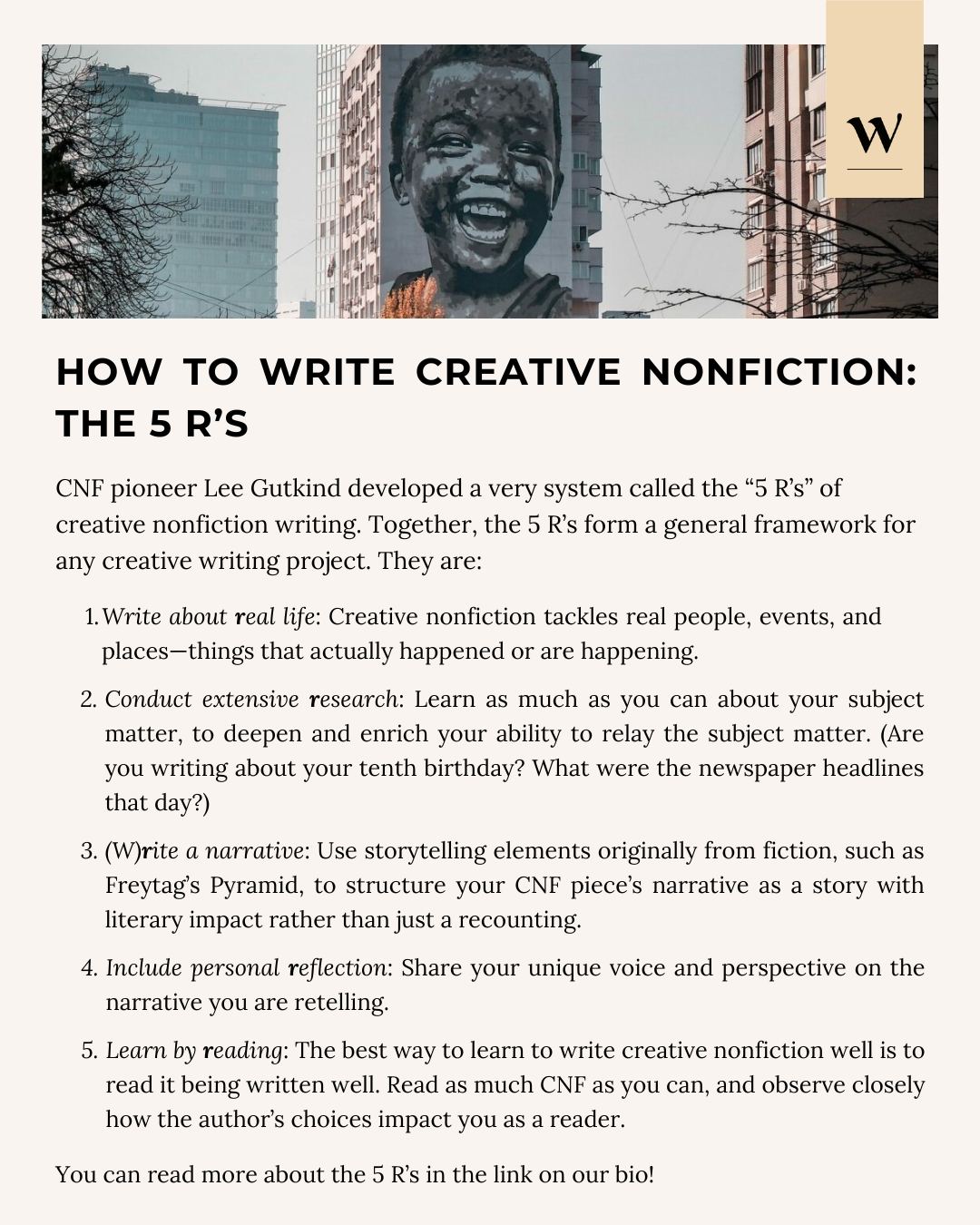
We’re sharing writing tips, creative prompts, and a steady stream of encouragement—follow us @writersdotcom. Click below to check out one of our latest posts on writing creative nonfiction.