Write into the Week: November 1, 2026
Elle LaMarca | November 1, 2026 |
“Jealousy is one of the occupational hazards of being a writer.” —Anne Lamott
 Dear Writer,
I hope you’re having a good start to your week. In this newsletter:
- A writing prompt to inspire your creativity.
- Reading and listening recommendations in fiction, nonfiction, and poetry.
- Publishing, residency, and retreat opportunities available now.
- Join our free Monday and Friday write-ins, and meet our community of writers.
Happy writing this week!
—Elle, Curriculum Specialist & Instructor
Writer to Writer: It Wasn’t You This Time
“What is good for one is good for all.” —Jean Rhys
Comparison is a natural part of being a writer. We compare our writing, skill levels, publication histories, acceptance rates, and seemingly everything else to those of other writers. No one likes to admit they do this, but, I assure you, most of us do.
I don’t think there is much use in pretending we can eliminate comparison altogether, and I certainly don’t think we need to feel ashamed when a little jealousy or envy sneaks in. Those are human emotions. The trouble begins when we let them settle in, take up too much space, and turn someone else’s good news into a reason to feel angry, resentful, or worse about ourselves.
There is an especially uncomfortable version of this that I suspect many of us have experienced: another writer succeeds, we don’t think their writing is as “good” as ours, and somewhere in the privacy of our minds comes the thought, That should have been me. Maybe they published the story because they submitted theirs while yours is still sitting in a folder, landed an agent while you haven’t started querying yet, entered the contest you only thought about competing in, or finished the novel you’re still working to complete. Either way, the truth is, it wasn’t you. In the rare instance that you really were competing for the same opportunity, another person made a subjective decision and chose their writing. You cannot control that. What you can do is pay attention to why their success bothered you so much.
Jealousy can be surprisingly useful when we stop treating it as proof that we’re terrible people and start asking what it’s trying to tell us. If someone announces that they’ve finished a novel and you immediately feel a pang of envy, maybe it means you simply want to finish yours. If another writer publishes a poem in a journal you admire, perhaps you want to begin submitting your own poetry more seriously. If someone signs with an agent and you think, I want that, well—there you go. That feeling of jealousy has just identified a desire. Instead of allowing comparison to convince you that someone else is ahead and you are behind, let it point you toward something you want to pursue. Push yourself to view their success as motivational and aspirational.
And while you’re at it, celebrate them. Send the congratulations; buy the book; share their publication news. Most importantly, tell another writer when you admire what they’ve accomplished. Supporting someone else doesn’t diminish the possibilities available to you, and I’ve found that generosity feels considerably better than resentment anyway. Their success is not evidence that you missed your chance. Instead, it’s a reminder that writers really do publish poems, win contests, find agents, publish books, and reach goals that once felt impossible to achieve.
It wasn’t you this time, but someday, it very well could be. In the meantime, let someone else have their moment—and let yourself be inspired by it.
Writing Prompt: Take Your Pick
I offer you three prompts to explore this week. Pick one, two or try all three!
- Change the color of an ordinary thing. Make the grass blue, a stop sign purple, fall leaves pink.
- Write the month of November. (Nope, not a typo! Put the month of November into words.)
- Write about the last time you, or a character, lied.
Reading Recommendations
- “Something Wicked This Way Comes: 10 Poems to Read This Halloween” via LitHub. For the readers and writers of eerie, haunting and horror-ish poems. Or, maybe, you like to read about more everyday horrors. Either way, there’s something for you here!
- “Fixing Up Our Home Means Making Memories My Husband Might Lose” by Josepha Natzke via Electric Literature. In this personal essay, Natzke uses the renovation of an old Chicago house as a structure for thinking about marriage, memory, and the unsettling discovery that her husband experiences the past very differently than she does. Natzke explores what it means to become the keeper of a shared history that may not be equally remembered by both people.
- “A Trip to the Moon” – by Nina Shuyler via Flash Fiction Magazine. In this flash fiction piece, uses a mother’s literal disappearance to explore the quieter ways a woman can vanish inside family life long before anyone fully understands what is happening. The story is eloquently told through the daughters’ matter-of-fact, childlike perspective. This is master level flash storytelling!
Listening Recommendations
- “How Chaos Theory Changed the Universe” via the Stuff You Should Know podcast. Not specifically about writing, but a topic of interest to writers! In this episode, Josh Clark and Chuck Bryant explore chaos theory and the idea that small changes within a complex system can lead to dramatically different outcomes. As a writer, you may find the concept especially useful for thinking about cause and effect on the page: how one choice, interruption, or seemingly minor detail can alter the direction of a character, a scene, or an entire story.
- “Téa Obreht Reads ‘Family Lore'” via The Writer’s Voice podcast from The New Yorker. In this episode. Téa Obreht reads “Family Lore,” a darkly funny and increasingly anxious story about new parenthood, superstition, and the lengths people will go to protect the people they love.
- “Gillian Flynn: How to Write Thrilling Stories” via the How I Write podcast. Gillian Flynn, the author of Gone Girl, discusses the craft behind her character-driven thrillers, including how she approaches suspense, plot, openings, and characters whose own flaws help create the trouble they’re in. She also discusses why persistence and stubbornness are such an essential part of finishing a novel.
Publishing Opportunities:
- Split/Lip Press – Submission Deadline: December 1, 2026. Currently open for creative nonfiction manuscript submissions, including essay collections, memoir, and hybrid work. Must be at least 125 pages. Split/Lip Press publishes innovative and culturally relevant books. They are dedicated to publishing boundary-breaking books. Does that sound like yours?
- Room Magazine’s Short Forms Contest – Submission Deadline: December 15, 2026. Room is hosting their annual contest for Short Forms. Your entry can be in any genre up to 500 words: one or two prose poems, flash fictions, flash creative non-fictions, or hybrid pieces. Apply ASAP as they close for submission when they meet their cap, even if it’s before the deadline!
- The Ray Bradbury Center Anthology – Submission Deadline: January 31, 2027. The Ray Bradbury Center and Apex Book Company are seeking original science fiction, horror, and other speculative fiction for After the Fire, a forthcoming anthology inspired by the spirit and social urgency of Ray Bradbury’s work. Stories may be up to 5,000 words and pay $0.10 per word on acceptanc.
Monday and Friday: Free Group Writing Sessions
Come write with us! Community write-ins are a great way to meet other writers, and carve out space in your calendar for your writing.
Monday: Write Into the Week with Elle
Join me (Elle) for an hour of mindset support, goal setting, community, and dedicated time to write! We’ll meet on Monday at 11 AM Eastern time, at this Zoom link: https://us02web.zoom.us/j/83999379617
Friday: Open Write-In
Join the Writers.com staff for a 90-minute writing session each Friday from 11 AM to 12:30 PM Eastern time. We will write together for the first hour. In the last, optional half hour, we’ll share our writing with one another and connect.
To add yourself, join our newsletter using the join box above, and add yourself to the “Friday Write-Ins” list at the bottom of any email. We’ll send you a Zoom link the morning of the call.
Join us on Instagram for more writing inspiration!
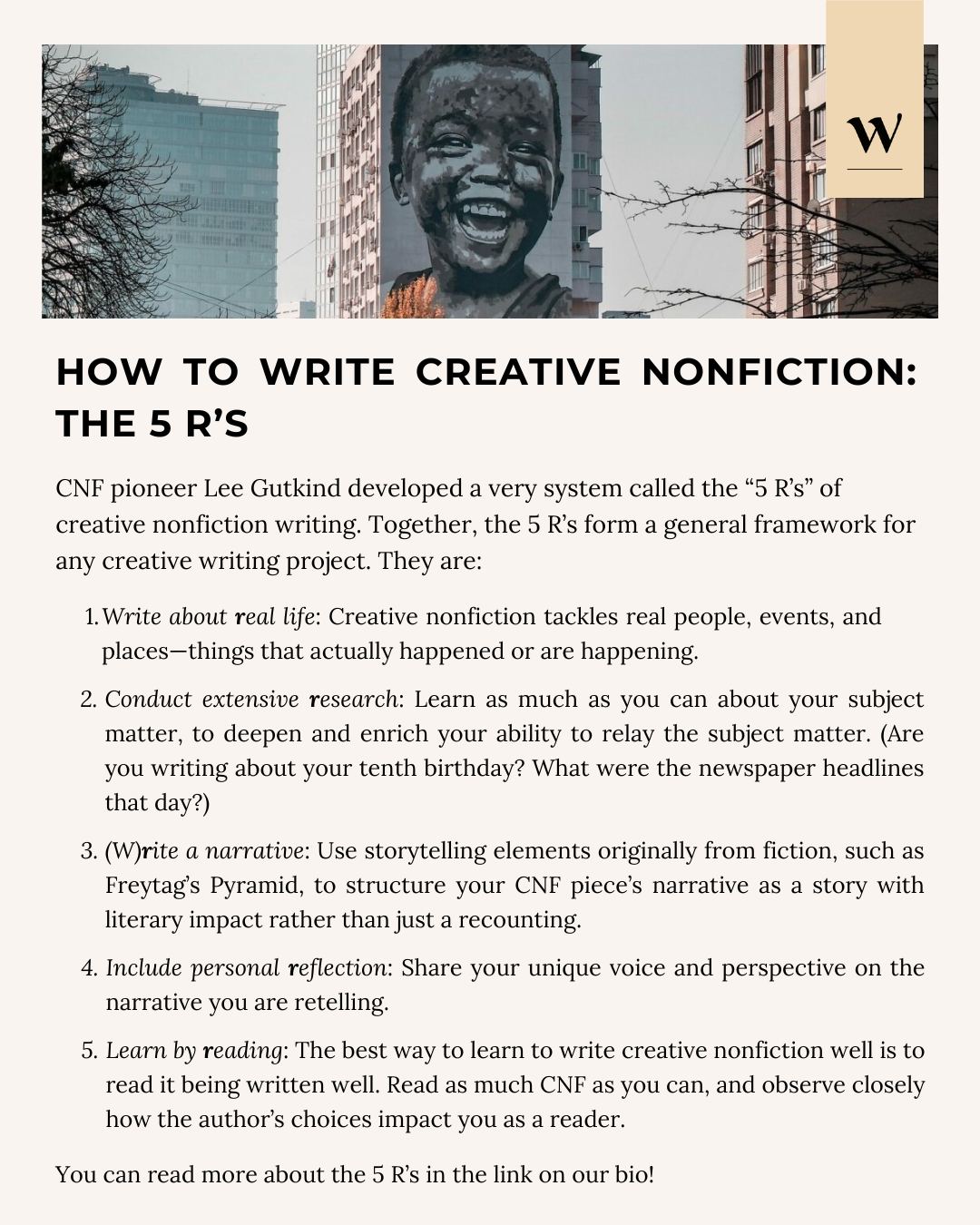
We’re sharing writing tips, creative prompts, and a steady stream of encouragement—follow us @writersdotcom. Click below to check out one of our latest posts on writing creative nonfiction.